
If you are planning a Gorilla Habituation Experience in Uganda, you may be wondering how many hours you spend with gorillas during habituation. The answer is up to four hours of viewing time once the gorilla group has been located, making habituation a much longer gorilla encounter than standard gorilla trekking, where visitors are allowed a maximum of one hour with a habituated gorilla family.
However, there is an important distinction that many travellers misunderstand. The four hours of gorilla viewing is not the total duration of the habituation experience. Your day also includes the morning briefing, entering Bwindi Impenetrable National Park, walking through the forest, tracking the gorilla group, locating the animals, and eventually walking back out of the forest. Depending on where the gorillas are and how they move, the complete experience can therefore take considerably longer than four hours.
For travellers specifically interested in how many hours you spend with gorillas during habituation, understanding this difference will help you plan your Uganda safari realistically.
How many hours do you spend with gorillas during habituation?
During the Gorilla Habituation Experience in Uganda, visitors are permitted to spend up to four hours observing the gorilla group once the group has been located. This extended viewing period is the defining feature of habituation and is one of the main reasons travellers choose it instead of ordinary gorilla trekking.
The Uganda Wildlife Authority’s guidelines distinguish between tracking time and viewing time. The viewing period begins when visitors reach the gorillas, while the overall tracking experience includes the time from the briefing until visitors return for debriefing.
This means that if somebody asks, “How many hours do you spend with gorillas during habituation?”, the most accurate answer is up to four hours of viewing. It does not mean that you arrive in Bwindi at 6:30 a.m., spend four hours in the forest, and automatically finish at 10:30 a.m.
The actual schedule depends on the location and movements of the gorilla family, the terrain, and the progress of the tracking team.
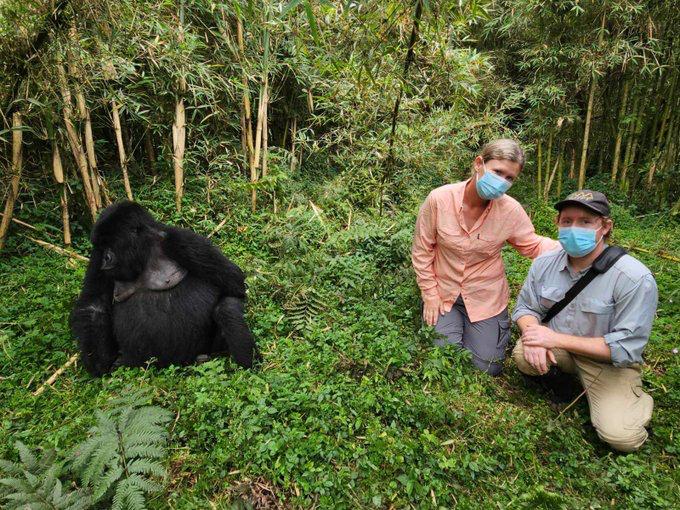
Does the four hours include the trek?
No. The four-hour gorilla viewing period is separate from the time spent trekking through the forest to find the gorillas.
Your morning starts with preparation and a briefing before you enter Bwindi. Once inside the forest, experienced guides and trackers lead you along the trails while searching for the habituating gorilla group. The time required to reach the family can vary considerably because mountain gorillas are wild animals that move through their natural habitat.
You may therefore spend several hours walking before reaching the gorillas. Once the group is located, the permitted viewing period begins.
After the encounter, you still need to walk out of the forest and return to the briefing point for debriefing. The total Gorilla Habituation Experience can therefore occupy much of your day.
What happens during the four hours with the gorillas?
The great advantage of spending up to four hours with gorillas is that you have time to observe much more than a single moment.
Mountain gorillas do not behave in a predictable or staged way. They may be feeding when you arrive, move through dense vegetation, rest beneath trees, interact with other members of the group, or become active again later. Having several hours available means you can observe these changing behaviours rather than rushing through a brief encounter.
During your Gorilla Habituation Experience in Uganda, you may watch adults feeding on vegetation, young gorillas playing, mothers caring for their infants, individuals grooming one another, and original members of the family communicating or moving together.
You may also observe the silverback and other adults as they interact with younger members of the group. Sometimes the gorillas may be highly active, while at other times they may spend considerable time resting.
This unpredictability is part of what makes gorilla habituation in Uganda so fascinating. You are not simply visiting an enclosure where animals behave according to a schedule. You are entering their natural environment and observing whatever behaviour occurs during your permitted viewing period.
Your guides and trackers also help you understand what is happening around you. Their knowledge of the forest and gorilla behaviour can make the experience much more meaningful because you can connect what you see with the social structure and daily life of the family.
Why is gorilla habituation four hours long?
The extended viewing period is connected to the purpose of the gorilla habituation process itself.
Habituation is the gradual process through which wild gorillas become accustomed to the presence of humans while continuing to behave naturally. It requires patience, careful monitoring, and repeated observation by trained trackers, researchers, and conservation personnel.
For visitors, this creates an opportunity to experience gorillas in a way that is more extensive than ordinary trekking.
Instead of arriving at a fully habituated family, observing them for a short period and leaving, the habituation experience provides more time to observe a group that is still part of this longer conservation and research process.
The four-hour period also gives visitors a better chance of seeing a wider range of natural behaviours. A gorilla family can change considerably over several hours. A group that is quietly resting when you first arrive may become active later, begin feeding, interact with younger gorillas, or move to another part of the forest.
That is why four hours with gorillas is not simply about having more time for photographs. It is about having more time to observe.
Is four hours guaranteed?
It is important to understand the phrase “up to four hours”.
The official rule provides a maximum viewing time of four hours, but visitors should not interpret this as a guarantee that the gorillas will remain in the same location for four continuous hours or that every aspect of the encounter will happen according to a fixed schedule.
The gorillas are wild animals, and their welfare comes first.
The ranger guides, trackers, and other members of the habituation team determine how the encounter is conducted. Their instructions should always be followed, particularly regarding distance, positioning, movement, and photography.
The location of the gorillas can also influence the experience. They may move deeper into the forest, travel through thick vegetation, or change direction during the encounter.
Therefore, when planning your gorilla habituation experience in Bwindi, think of four hours as the maximum permitted viewing period rather than a rigid appointment lasting exactly four hours.
Gorilla Habituation vs Gorilla Trekking: How Much Time Do You Get?
The difference in viewing time is one of the clearest distinctions between gorilla habituation vs gorilla trekking.
During standard gorilla trekking, visitors are allowed a maximum of one hour of viewing once the gorilla family has been located. During the Gorilla Habituation Experience, the maximum viewing time is four hours.
| Experience | Maximum Viewing Time | Main Experience |
|---|---|---|
| Gorilla Trekking | 1 hour | Observing a fully habituated gorilla family |
| Gorilla Habituation | Up to 4 hours | Extended observation of a gorilla group undergoing habituation |
This difference makes habituation particularly attractive to people who want more time with mountain gorillas.
However, more time does not automatically mean that habituation is the right choice for every traveler. Standard trekking may be ideal for visitors who want a shorter wildlife encounter, while habituation is better suited to travellers who have a strong interest in primates, photography, conservation, or detailed observation.
If you are still deciding between the two experiences, our guide to Gorilla Habituation Tours and Permits in Uganda can help you understand the wider differences, permits, and planning considerations.
Where does gorilla habituation take place?
The Gorilla Habituation Experience in Uganda takes place in Bwindi Impenetrable National Park, one of Uganda’s most important mountain gorilla habitats.
Bwindi has several gorillas trekking sectors, including Buhoma, Ruhija, Rushaga, and Nkuringo. The habituation experience is associated with the Rushaga sector, located in the southern part of the forest.
This makes Rushaga particularly important for travellers whose primary objective is to spend extended time with gorillas.
Because the habituation activity begins early, staying close to Rushaga the night before is usually the most practical arrangement. It reduces the need for a very long morning transfer and allows you to arrive at the briefing point on time.
The forest itself is an important part of the experience. Bwindi is mountainous, heavily forested, and often humid, and the terrain can be demanding. The difficulty of the hike depends on where the gorillas are located and the conditions on the day.
What time does gorilla habituation start?
The Gorilla Habituation Experience starts early in the morning.
Uganda Wildlife Authority guidelines specify a starting time of 6:30 a.m. for Gorilla Habituation Experience tracking.
This is one reason travellers should stay near the Rushaga sector rather than attempting to arrive from a distant location on the same morning.
Your morning normally involves getting ready early, having breakfast, and proceeding to the relevant briefing point. The guides and trackers then explain the rules and expectations before the group enters the forest.
Once you begin walking, the duration becomes less predictable because the location of the gorillas determines how long it takes to find them.
Is Gorilla Habituation Worth It for Four Hours?
For travellers who specifically want more time with mountain gorillas, the answer is yes.
The value of habituation comes from the opportunity to slow down and observe rather than simply see.
One hour can pass very quickly when you are surrounded by gorillas. You may initially be focused on taking photographs or identifying individual animals, and before you have consumed the experience, the viewing period is over.
With up to four hours, there is much more time to settle into the environment and observe the gorillas’ behaviour.
You may notice interactions that would be easy to miss during a shorter encounter. Young gorillas may become playful, adults may move between different areas, individuals may groom one another, and the family may change its activity several times during the observation period.
This makes habituation particularly attractive to photographers, wildlife enthusiasts, primate lovers, and travellers who have already experienced standard gorilla trekking and want something more immersive.
How difficult is a four-hour gorilla habituation experience?
It is important not to confuse four hours of gorilla viewing with four hours of continuous hiking.
The physical challenge comes primarily from reaching the gorillas and returning through the forest.
Bwindi is a mountainous rainforest with steep sections, dense vegetation, and sometimes muddy or slippery trails. Depending on where the gorilla family has moved, you may need to hike for a significant amount of time before reaching them.
Weather can also influence trail conditions.
For this reason, travellers should prepare for a genuine forest hike rather than a simple walk. Good hiking shoes, long trousers, a waterproof jacket, drinking water, and a small backpack are useful.
A porter can also be hired locally to help carry your belongings and assist you on difficult sections of the trail.
Your physical effort is therefore determined by both the trek and the environment, not simply by the four-hour viewing period.
How many people can go for gorilla habituation?
Gorilla habituation is a specialised experience and is more limited than ordinary gorilla trekking.
The controlled nature of the experience is important because the welfare of the gorillas must remain the priority. Visitors are accompanied by trained personnel who manage the encounter and ensure that the established rules are followed.
This is another reason you should arrange your permit before travelling rather than assuming you can simply arrive at Bwindi and join a habituation group.
If you are travelling during a busy period, early planning is especially important.
The Four Hours Are About More Than Watching Gorillas
It is easy to describe habituation simply as four hours with gorillas, but that does not fully explain the experience.
You are entering the natural habitat of one of the world’s most endangered great apes and observing a family in its own environment.
The experience gives you time to appreciate details that can easily be missed during a shorter encounter: the way a mother interacts with her infant, how younger gorillas play, how adults respond to one another, and how the group moves through the forest.
It is also an opportunity to learn about the conservation work surrounding mountain gorillas in Uganda.
Bwindi is home to a significant proportion of the world’s remaining mountain gorillas, making responsible tourism particularly important. By following the rules established by the conservation authorities and listening to the guides, visitors contribute to a tourism model designed around protecting the animals and their habitat.
This is why gorilla habituation in Rushaga should be approached with respect and patience. The objective is not to get as close as possible or to force a particular photograph. The objective is to observe the gorillas responsibly while allowing them to behave naturally.
What Should You Expect on the Day?
A typical Gorilla Habituation Experience begins early, with the briefing taking place before you enter the forest.
You then walk with your guides and trackers into Bwindi. The trackers use information about the gorilla group’s movements to help determine where the animals are likely to be.
The length of this initial trek can vary. Sometimes the group may be reached relatively quickly, while on another day you may need to hike farther.
Once the gorillas are located, your gorilla viewing time begins.
This is when you can spend up to four hours observing the family. You may watch them feed, rest, move, interact, and respond to one another while the guides explain what you are seeing.
When the permitted viewing period ends, you leave the gorillas and begin the return journey through the forest.
The day therefore consists of much more than the four-hour encounter itself.
Is Gorilla Habituation Better for Photography?
For wildlife photographers, the longer viewing period can be a major advantage.
Having more time increases the possibility of observing different behaviours and finding better photographic opportunities. A gorilla may move into a clearer position, interact with another member of the family, or become active after spending time resting.
However, photography must never take priority over the welfare of the animals.
Visitors should follow the instructions of the ranger guides and maintain the required distance. Flash photography and other prohibited practices should be avoided, and photographers should be prepared to put the camera down when instructed.
The best photographs often come from patience rather than trying to control the encounter.
Ultimate Answer: How Many Hours Do You Spend With Gorillas During Habituation?
So, how many hours do you spend with gorillas during habituation?
The answer is up to four hours of viewing time once the gorilla group has been located.
That four-hour period is separate from the time spent trekking through Bwindi to find the gorillas and the time required to return from the forest. The complete Gorilla Habituation Experience in Uganda can therefore take much longer than four hours.
The biggest difference between habituation and ordinary gorilla trekking is the extended viewing opportunity. Standard trekking allows a maximum of one hour with a gorilla family, while habituation allows up to four hours.
If your goal is to spend more time observing mountain gorillas, understand their behaviour, and experience a deeper encounter in their natural habitat, gorilla habituation in Rushaga, Bwindi offers one of Uganda’s most immersive primate experiences.
For travellers ready to plan the experience, you can continue to our guide on Gorilla Habituation Tours and Permits in Uganda, or explore our 2 Days Gorilla Habituation Tour From Kigali, 3 Days Uganda Gorilla Habituation Tour From Kigali, 5 Days Uganda Gorilla Habituation and Wildlife Safari, and 10 Days Gorilla Habituation with a Uganda Safari itineraries.