
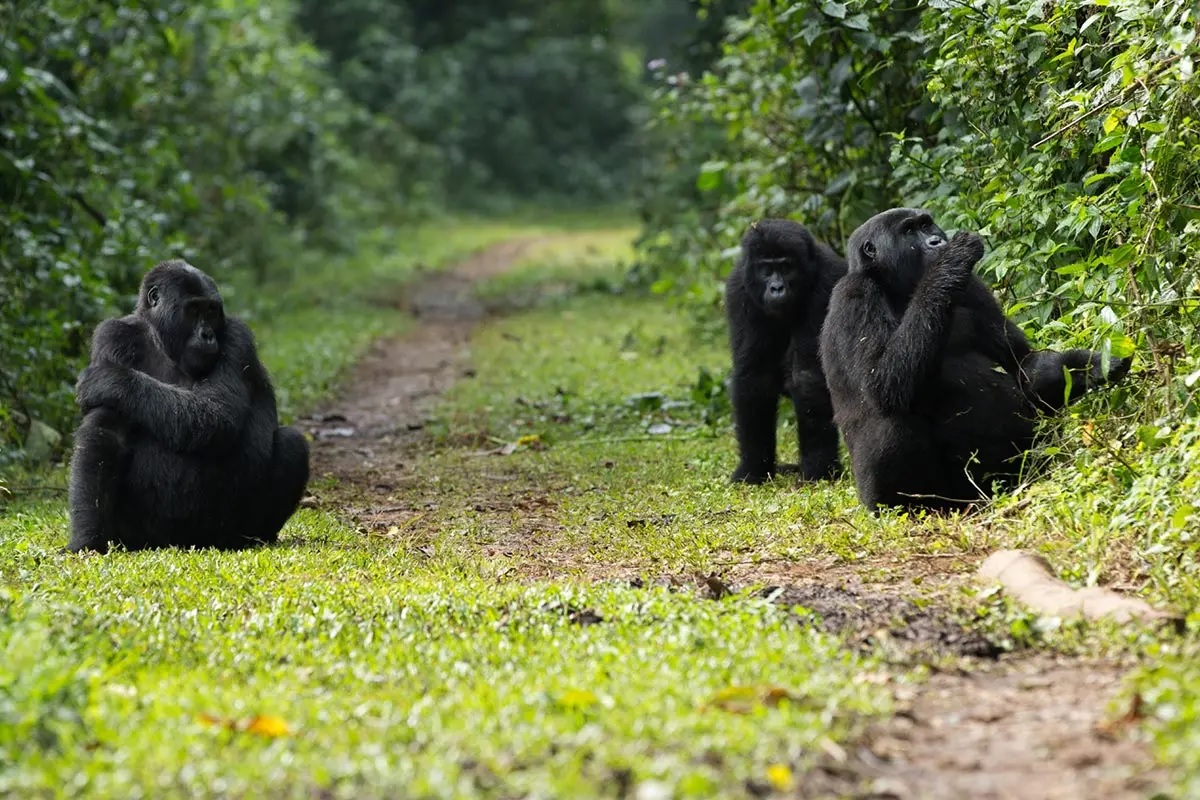
Tourist attractions in Bwindi Impenetrable National Park: Bwindi Impenetrable National Park was established in 1991 and later declared a UNESCO site in 1994. The park is located in southwestern Uganda and is one of the best places in Africa to see gorillas in the wild. It covers an area of over 321 square kilometers at an altitude of over 1160 meters to 2607 meters above sea level. With over 1000 mountain gorillas remaining in the world today, Bwindi Impenetrable National Park harbors 459 mountain gorillas, more than half of the world’s population. The mountain gorillas in Bwindi are scattered across the park’s four sectors, including the Buhoma, Rushaga, Nkuringo, and Ruhija gorilla sectors.
In 1932 before Bwindi Impenetrable National Park was gazette as a national park, it was a game reserve. This reserve was divided into two parts, the first on the northern side and named Kayonza Crown Forest Reserve. The southern part was called Kasatora Crown Forest Reserve and both of these areas covered over 207 square kilometers. In 1942, this area was established as the Bwindi Impenetrable Forest Reserve because of the impressive flora species it exhibited. Shortly after the first sighting of the mountain gorillas in 1964, the forest reserve was designated an animal sanctuary. This lasted until 1992 when it officially gained the national park status and elevated to Bwindi Impenetrable National Park.
What are some of the tourist attractions in Bwindi Impenetrable National Park?
Bwindi Impenetrable National Park given its sheer size of 331 square kilometers, is home to incredible attractions that are worth every tourist’s bucket list. The following are some of the tourist attractions in Bwindi Impenetrable National Park.
Mountain gorillas
The park as mentioned earlier is home to more than half of the world’s population. This makes Bwindi Impenetrable National Park the best mountain gorilla destination in the world. Mountain gorillas are considered endangered because they are only present in the Virunga conservation area in the whole world. This conservation area engulfs national parks like Bwindi Impenetrable and Mgahinga Gorilla National Parks of Uganda, Virunga National Park of the Democratic Republic of Congo, and Rwanda’s Volcanoes National Park. Mountain gorillas are social beings who live in groups known as gorilla families and Bwindi Impenetrable National Park has over 50 families. Among these gorilla families in the park, 26 families are habituated and available for trekking.

Birdlife
Although Bwindi Impenetrable National Park is a popular gorilla destination in the world, it is also a famous bird habitat in the country. This is because the park harbors over 400 bird species that can be spotted on a birding adventure experience. The different landscape of the park favors the breeding of many different bird species from endemic residents to the rare migratory species. There are 23 of the 24 birds are natives and only restricted to the Albertine region of the Rift Valley which makes up over 90% of the total Albertine endemic birds in Uganda.
Some of the major bird species to see in the Bwindi Impenetrable National Park include; the African green broadbill, grey cuckoo-shrike, Shelly’s greenbul, yellow-streaked greenbul, red-throated alethe, archer’s robin-chat, white-bellied robin-chat, kivu ground-thrush, mountain yellow warbler, Grauer’s rush warbler, and red-faced woodland warbler to mention but a few.
Cultural Encounters
Bwindi Impenetrable National Park was also home to the Batwa pygmies who are also known as the forest keepers. They lived in the forest and survived by hunting small animals and gathering fruits. They lived peacefully together with the mountain gorillas and other animals in the forest for a long time. When Bwindi Impenetrable National Park was gazette in 1992, the Batwa were forced out of the forest to the neighboring areas. Their traditional ways of living and dependence on the natural forest for survival are truly a misery worth checking out.
Wildlife
Other wildlife species in the park also attract tourists from far and wide for leisure and research. Some of these animals like elephants, 9 other primate species such as red-tailed, chimpanzees, L’Hoest’s, blue monkeys, black and white colobus, baboons among others, giant hogs, and the rest. Elephants in Bwindi are estimated to be 30 to 50 and of two species, the forest elephant and the savannah elephant. In the dry season, they often feed on barks of mature forests in the Mubwindi swamp area but in the wet season, they feed on bamboo shoots.
Flora species
The impenetrable forest of Bwindi harbors some of the oldest flora species that have been in the forest for more than 25,000 years. This makes it one of the most treasured natural forests in the world. There are over 400 plant species of which 100 are fem species and 200 of these are different tree species notable ones being African brown mahogany trees, ceiba trees, and cecropia trees. Over half of the entire Bwindi Impenetrable National Park is a mixed forest such as Newtonia, red stinkwood, East African yellow wood, strombosia scheffleri, and Symphonia globulifera.
Lake Mutanda
Lake Mutanda is a small freshwater lake located in the south part of Bwindi Impenetrable National Park. Its fresh waters offer an opportunity to tourists who like an adventure to swim in the wild. Lake Mutanda offers a scenery view of the Virunga mountain ranges in the Democratic Republic of Congo at an altitude of 1,800 meters, it is a great place to hike. It is also drained by River Rutshuru which flows northwards to Lake Edward.
What is the best time to travel to Bwindi Impenetrable National Park?
Depending on a particular activity a visitor is interested in experiencing, any time of the year is great for traveling to Bwindi Impenetrable National Park. The park given its location close to the equator, receives a tropical type of climate. This is characterized by two wet and dry seasons throughout the year. The dry season of June to September and December to February is best for encountering attractions like gorillas and other wildlife species. This is because the trails to these attractions are dry with sparse vegetation due to little or no rain in this season.
However, the wet season is also a great season to encounter various species of birds, especially migratory birds. This is because the wet season is usually the breeding season for most of the bird species. Hence Bwindi Impenetrable National Park is open for visiting any time of the year.
Further planning resources for Tourist Attractions in Bwindi Impenetrable National Park
Compare the complete safari package library, destination guides, safari experiences, Gorilla Uganda travel journal. For independent destination and conservation context, consult Uganda Wildlife Authority. Use official sources for general background and confirm current fees, access, schedules, permits and operating rules for the exact travel dates before payment. Internal Gorilla Uganda pages help compare route structure and travel style, while the open inquiry form allows a local specialist to check how the information applies to a private journey.