
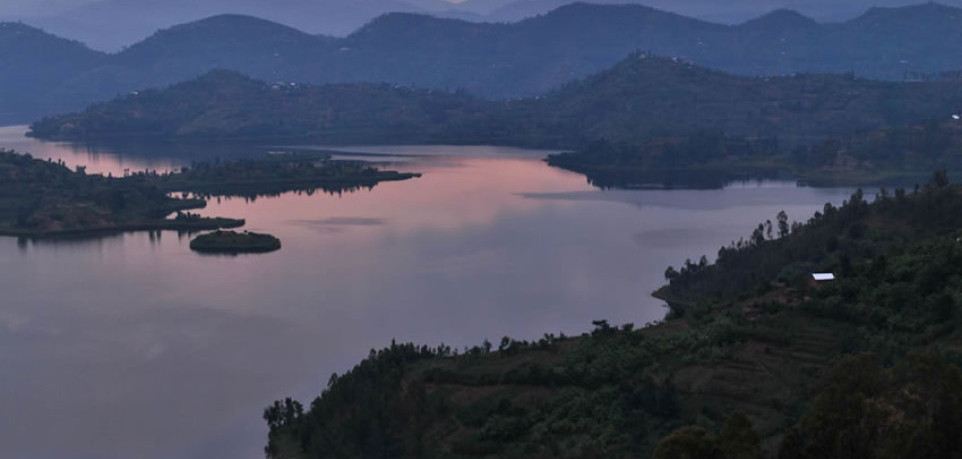
Rwanda Twin Lakes – Ruhondo and Burera
Rwanda Twin Lakes – Ruhondo and Burera. The reason lakes Ruhondo and Burera are known as Rwanda’s twin lakes is that they are physically joined at a location where one lake empties into the other and are geographically close to one another. Located in the northern region of Rwanda, in the Musanze district at the foot of Mount Muhabura, not far from Volcanoes National Park.
The twin lakes were formed as a result of a volcanic eruption in the Virunga ranges and have a total surface area of 2800 hectares. The two lakes are thought to have been created after river Nyabarongo, which flows towards the northern region of Rwanda was blocked by volcanic glaciers from the erupted volcanoes. They are therefore lava-dammed lakes, and the greenery that surrounds them gives their waters a green appearance adding to their mystical quality.
The Twin Lakes region is particularly picturesque, with high, heavily farmed hills encircling the clear, deep blue waters. They provide stunning landscapes of the entire Virunga Volcanoes. In the hills and at a few locations near the lakes, you can go for a walk and see birds. The majority of these characteristics, which are comparable to Lake Bunyonyi, are best seen from Virunga Lodge, which is perched on a hilltop overlooking both lakes.
Visitors can rent a boat at Lake Ruhondo to take a relaxing lake trip and see a variety of water birds, including herons, hammerkops, cranes, and kingfishers.
According to research, these lakes are around 180 meters deep, and the water is suitable for drinking and other uses by both people and animals. Additionally, they are crocodile and bilharzia free.
The lakes provide visitors with a stunning perspective of the surroundings, including wetlands, indigenous populations, the Virunga volcanoes, and tourist destinations in neighboring Uganda and the Democratic Republic of the Congo. In addition to gorilla safaris in Volcanoes National Park, cultural excursions, bird viewing, and trekking volcanoes, a boat trip on the pure waters of Rwanda’s twin lakes completes the safari experience.
Activities carried out at Rwanda’s twin lakes
Fishing
You can participate in fishing activities while on your safari at these lakes; local fishermen will teach you how to use baskets, nets, and spears. If you wish to participate in fishing, you can either bring your equipment or rent it on-site.
Bird Watching
There is a wide variety of birdlife in and around these twin lakes, as well as on many islands. While canoeing or on a nature walk in and around these lakes, you’ll be able to enjoy the sight of a variety of bird species. Among the species that can be seen are Sacred ibis, African fish eagles, and herons.
Canoeing and Boat Cruise
You can visit other islands, including Muhabura and Cuza, by boat or by canoe. Tourists have the opportunity to discover more voluminous birdlife, terraced hills, and lush vegetation whilst enjoying the boat rides.
Community tours
A stroll to the neighborhood gives you the chance to meet the locals and take part in music and dance performances as the elderly tell you stories from Rwandan folklore.
Farm tours
People go for walks and visit the locals’ farms and gardens in the nearby towns and islands. Depending on the season, visitors can also perform hand digging, harvesting, or weeding. To further enrich your experience, you can also sample locally produced food made by locals.
Photography
The twin lakes are flanked by well-terraced hills, blue skies during the dry seasons, and deep, crystal-clear waters, excellent for photo shoots. This is the best thing to do on Rwanda’s Twin Lakes – Ruhondo and Burera.
Swimming
Visitors can come prepared to participate in this workout and with their swimming clothes because these lakes are bilharzia and crocodile-free. Only experienced swimmers are permitted to participate since these twin lakes are deep (approximately 180 meters), reducing the number of drowning events.
You can visit these twin lakes whenever you like, depending on your schedule though it is advised to book earlier.
How to get to Rwanda’s twin lakes – Ruhondo and Burera?
These lakes are conveniently accessible from Volcanoes National Park. Another choice is for tourists coming from Uganda’s Mgahinga National Park to use the Cyanika boarder route through the Kisoro district; this can take 1-2 hours to drive. When using air transport, Kigali airport, which is 150 kilometers away from the lakes, and by car, it takes about 2 hours. Typically, a gorilla tracking safari in Rwanda is followed by a trip to these lakes.
A detailed introduction to Rwanda Twin Lakes – Ruhondo and Burera
Rwanda Twin Lakes – Ruhondo and Burera is best understood as more than a name on an itinerary. It is a practical way to experience Rwanda through an East African journey, supported by local guiding and enough time to notice landscapes, wildlife, local knowledge and the rhythm of travel between carefully chosen stops. The page above explains the central subject; this planning section adds the decisions that turn that information into a workable trip. Travellers should think about the season, the length of each transfer, the amount of activity they enjoy, the standard of accommodation they prefer and how much unstructured time they want. The strongest itineraries leave room for real observations instead of rushing from one headline sight to another. In Rwanda, conditions can change between regions even during the same journey, so a route should be checked as a complete sequence rather than as a list of separate attractions. Start with the experience that matters most, then build transport, rest and secondary visits around it. That approach keeps Rwanda Twin Lakes – Ruhondo and Burera rewarding for first-time visitors, experienced safari travellers, couples, families and private groups with different interests. For independent protected-area and conservation context, consult Visit Rwanda national parks and confirm operational details again near the travel date.
How to plan the timing and route
Timing for Rwanda Twin Lakes – Ruhondo and Burera is not only a question of choosing a month. It also involves arrival time, road or flight connections, permit availability where controlled activities are included, and the realistic pace of each day. Dry periods can make some roads and trails easier, while greener months may bring dramatic skies, fresh vegetation and fewer visitors in certain areas. Rain can occur in any season, particularly around forests and highlands, so flexibility remains useful. A local planner should confirm current park rules and access before final payment because official conditions can change. Use the Rwanda safari collection to compare journeys in the same region, then review the complete safari collection if you may want to combine countries. Arriving a night before a major trek or long game-drive day is often more comfortable than connecting directly from an international flight. When the route covers several borders, build in sensible buffers and avoid treating every transfer as guaranteed to take the shortest possible time.
Further planning resources for Rwanda Twin Lakes – Ruhondo and Burera
Compare the safari experiences. Use official sources for general background and confirm current fees, access, schedules, permits and operating rules for the exact travel dates before payment. Internal Gorilla Uganda pages help compare route structure and travel style, while the open inquiry form allows a local specialist to check how the information applies to a private journey.