
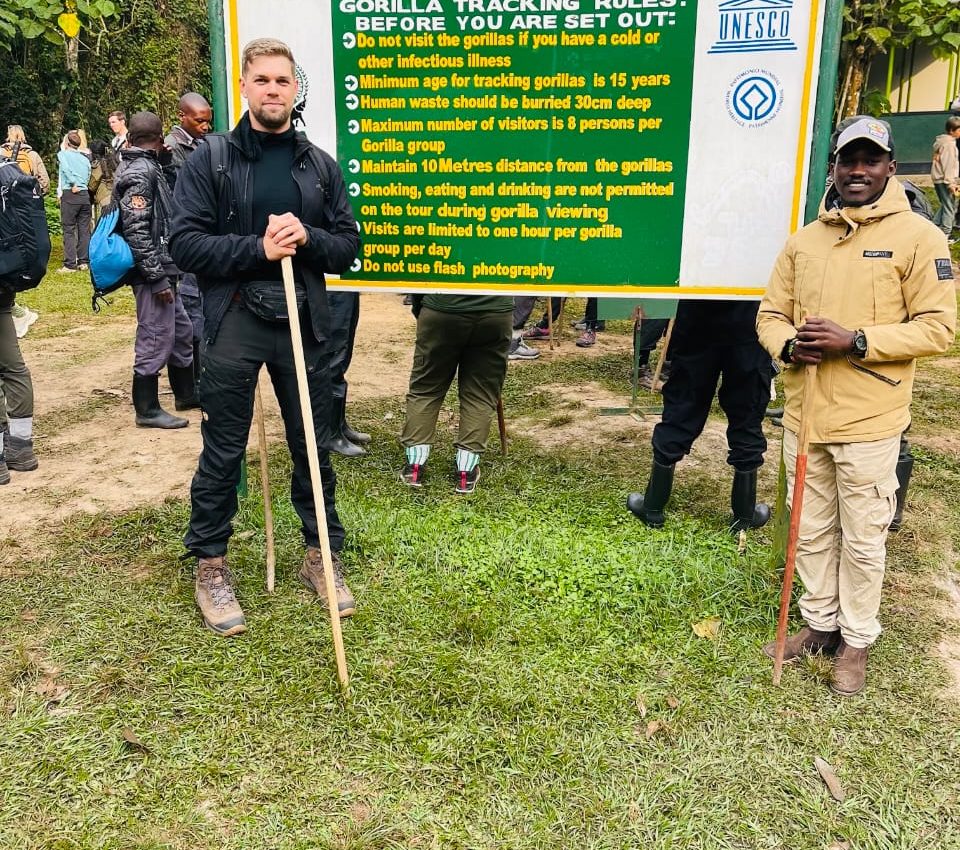
If you are planning a Gorilla Habituation Experience in Uganda, one of the first questions to answer is: Where does gorilla habituation take place? The experience is conducted in Bwindi Impenetrable National Park, in southwestern Uganda, with the habituation experience associated particularly with the Rushaga sector in southern Bwindi. Uganda Wildlife Authority confirms that the Gorilla Habituation Experience allows visitors to accompany researchers and habituators into the forest as part of the process of habituating gorillas to human presence.
Unlike ordinary gorilla trekking, where visitors search for an already habituated gorilla family and receive a regulated viewing period, habituation takes place with gorilla groups that are still becoming accustomed to human presence. This makes the experience particularly attractive to travellers who want a longer and more immersive encounter with mountain gorillas.
Where in Uganda does gorilla habituation take place?
The Gorilla Habituation Experience takes place in Bwindi Impenetrable National Park, one of Uganda’s most important mountain gorilla conservation areas.
Bwindi is located in southwestern Uganda and is divided into four main tourism sectors: Buhoma, Ruhija, Rushaga, and Nkuringo. UWA identifies these as the main sectors and designated entry points for gorilla activities.
However, travellers should not assume that every sector offers the Gorilla Habituation Experience. Rushaga is the key sector associated with gorilla habituation in Uganda, making southern Bwindi the area to focus on when planning this activity.
This distinction is important because someone searching for a standard gorilla trek may have several sector options, while someone specifically looking for habituation needs to plan around the availability of the habituation experience.
Gorilla habituation takes place in the Rushaga sector
The Rushaga sector is located in the southern part of Bwindi Impenetrable National Park.
It is one of the most important areas for travellers interested in gorilla habituation because the experience is conducted with gorilla groups undergoing the habituation process.
Rushaga is also strategically located for combining Gorilla Habituation with other attractions in southwestern Uganda. Travellers can combine the experience with destinations such as Lake Bunyonyi, Lake Mutanda, Mgahinga Gorilla National Park and Queen Elizabeth National Park, depending on the length of their safari.
For example, someone travelling from Kigali can cross into Uganda through the Cyanika or Katuna border and continue toward southwestern Uganda before reaching the Bwindi area. The exact route depends on the border crossing, accommodation, and the sector where the activity is scheduled.
Does gorilla habituation take place in Mgahinga?
This is an important distinction.
Uganda has two national parks where mountain gorillas occur: Bwindi Impenetrable National Park and Mgahinga Gorilla National Park. UWA confirms that gorilla tracking in Uganda takes place in both parks.
However, gorilla habituation should not be confused with gorilla trekking in Mgahinga.
Mgahinga offers gorilla trekking, while the specialized Gorilla Habituation Experience is associated with Bwindi. UWA’s current activity guidance specifically describes Gorilla Habituation as an experience in which visitors accompany researchers and habituators into the forest to participate in the habituation process.
So if your primary goal is to participate in a Gorilla Habituation Experience in Uganda, you should plan your safari around Bwindi rather than Mgahinga.
What is the difference between Bwindi Gorilla Trekking and Gorilla Habituation?
Both experiences take place in the natural environment of Bwindi, but they are designed differently.
With standard gorilla trekking, visitors search for a gorilla family that has already been habituated to human presence. Once the family is located, visitors have a regulated viewing period.
With Gorilla Habituation, visitors accompany researchers, trackers, and habituators as they work with a gorilla group that is still becoming accustomed to human presence. The purpose is not simply to observe the gorillas but also to understand and participate in a carefully managed conservation process.
The current Uganda Wildlife Authority tariff also lists gorilla habituation separately from standard gorilla tracking, reflecting the fact that these are distinct tourism products.
Why is Rushaga important for gorilla habituation?
Rushaga is particularly important because of its location in southern Bwindi and its association with habituation activities.
For travellers, staying near Rushaga can make the experience more convenient because you are closer to the relevant briefing and starting point instead of travelling across the park from another sector.
This is one reason choosing the right accommodation is important when booking a Uganda Gorilla Habituation Safari.
How do you get to the gorilla habituation starting point?
Your route to Bwindi Gorilla Habituation depends on where your safari begins.
From Kigali, Rwanda
Kigali is one of the most convenient international starting points for a short gorilla habituation safari.
Travellers can drive from Kigali toward the Rwanda-Uganda border and continue into southwestern Uganda. Depending on the selected border crossing and itinerary, the journey can be arranged to reach the Rushaga area of Bwindi.
This is why short packages such as 2 Days Gorilla Habituation Tour From Kigali and 3 Days Gorilla Habituation Tour from Kigali are possible.
For travellers already in Rwanda, crossing into Uganda can save considerable driving time compared with beginning the journey from Entebbe or Kampala.
From Entebbe or Kampala
Travellers starting in Uganda normally travel westward toward southwestern Uganda.
The journey is considerably longer than starting from Kigali, but it can easily be incorporated into a longer Uganda safari.
For example, a longer itinerary could combine Gorilla Habituation, Queen Elizabeth National Park, Kibale Forest, Lake Mburo, or other Ugandan destinations.
UWA notes that Bwindi’s southern sectors, including Rushaga and Nkuringo, can also be accessed by flights to Kisoro Airstrip, followed by a road transfer.
Where Should You Stay for Gorilla Habituation?
If your primary reason for visiting Bwindi is the Gorilla Habituation Experience, I recommend choosing accommodation that provides convenient access to the Rushaga area.
There are different accommodation levels around southern Bwindi, ranging from budget and community-oriented accommodation to comfortable mid-range and luxury lodges. The best choice depends on your budget and whether Gorilla Habituation is the only activity on your itinerary.
For a short two-day experience, staying close to the habituation starting point is especially useful because the activity normally begins early in the morning.
For a longer safari, you can choose accommodation based on the overall route rather than simply the habituation activity.
Can you combine gorilla habituation with other activities?
Absolutely.
One advantage of doing gorilla habituation in southern Bwindi is that it can be incorporated into a wider Uganda safari.
Popular combinations include:
- Gorilla Habituation + Lake Bunyonyi
- Gorilla Habituation + Mgahinga
- Gorilla Habituation + Queen Elizabeth National Park
- Gorilla habituation + chimpanzee trekking
- Gorilla Habituation + Wildlife Safari
- Gorilla Habituation + Lake Mburo
- Gorilla Habituation + Rwanda Safari
For travellers with more time, a Gorilla Habituation Experience can become the highlight of a much longer Uganda primates and wildlife itinerary. This also creates opportunities to experience Uganda beyond gorillas, including savannah wildlife, crater lakes, forests and local communities.
How long do you spend with the gorillas?
The location of Gorilla Habituation is important, but so is the nature of the experience once you reach the forest.
A Gorilla Habituation Experience is designed around a longer period of observation than standard gorilla trekking. The advertised experience allows visitors to spend up to four hours with the gorilla group once it has been located, although the overall duration of the forest activity can be longer because finding the gorillas and moving through the forest takes time.
If this longer encounter is the main reason you are considering habituation, you may also want to read our detailed guide on how many hours you spend with gorillas during habituation.
Is Gorilla Habituation Available Every Day?
The experience is subject to permit availability and operational arrangements, so travellers should not simply arrive at Bwindi expecting to participate.
A Gorilla Habituation permit needs to be secured for the appropriate date, and the activity is organized through Uganda’s wildlife management system.
UWA’s guidelines state that permits are booked according to designated dates and entry points, with visitors allocated to gorilla groups according to the approved procedures.
For this reason, I recommend confirming the habituation permit before booking non-refundable accommodation or building flights around a particular date.
Ultimate Answer: Where does gorilla habituation take place?
So, where does gorilla habituation take place?
The answer is Bwindi Impenetrable National Park in southwestern Uganda, with the Rushaga sector in southern Bwindi being the key area associated with the Gorilla Habituation Experience.
While Uganda’s mountain gorillas are found in both Bwindi and Mgahinga, standard gorilla trekking is available in both parks, whereas the specialized habituation experience is associated with Bwindi.
If you specifically want to spend more time observing gorillas and accompany researchers and habituators during the habituation process, Rushaga, Bwindi, is the location you should plan around.