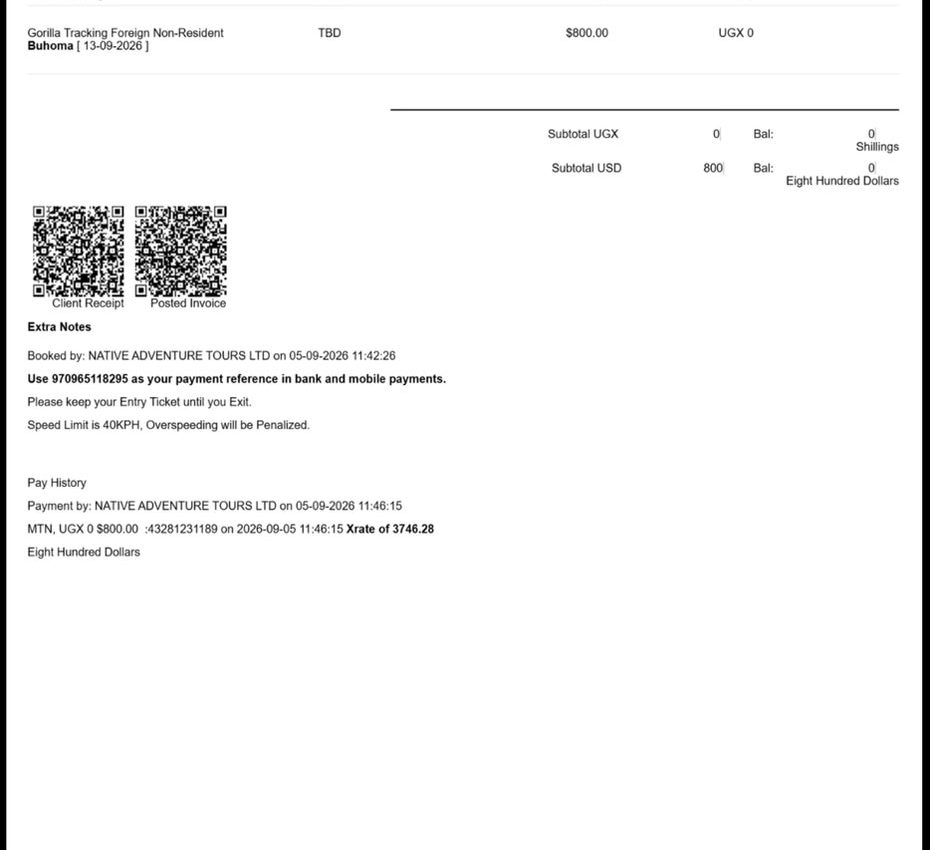
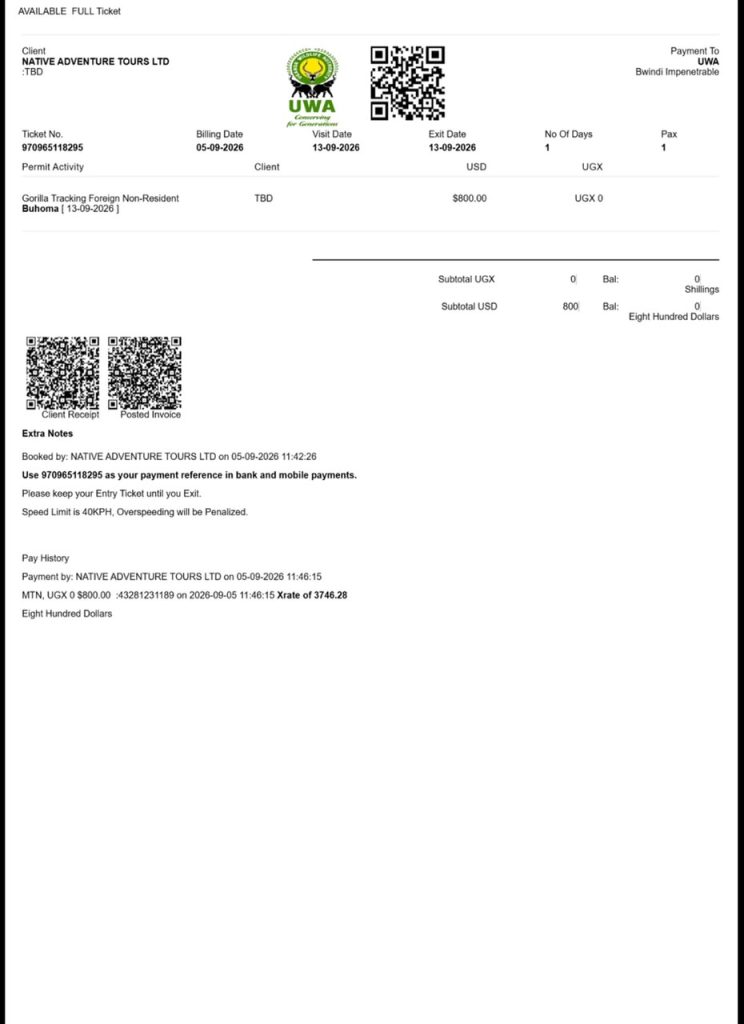
What is the cost of a Uganda gorilla permit? For most international visitors, the standard Uganda gorilla trekking permit costs US$800 per person under the current standard tariff for foreign non-residents. Foreign residents pay US$700, visitors in the Rest of Africa category pay US$500, while East African Community citizens pay UGX 300,000. Uganda also introduced a lower seasonal rate for eligible foreign non-resident gorilla tracking dates in April, May, and November 2026, when the permit costs US$600 per person.
However, the cost of a Uganda gorilla permit is only one part of the total cost of a gorilla safari. The permit gives you access to the regulated gorilla tracking experience, but you will still need to budget for accommodation, transportation, meals, a safari vehicle and guide, and potentially domestic flights, porters, and other activities.
This is why understanding the permit price alone is not enough when planning a Uganda gorilla safari. A couple spending US$1,600 on two standard permits could end up with a very different total safari cost depending on whether they choose a mid-range lodge and road transport or a luxury lodge and flying safari.
In this guide, we explain what is the cost of a Uganda gorilla permit, who qualifies for each permit category, what the permit includes, what it does not include, how the 2026 low-season rate works, how much two or four travellers would pay, and how the permit fits into the overall cost of a Uganda gorilla safari.
If you are planning your trek and want help checking the applicable permit category, trekking date, and Bwindi sector, Native Africa Tours can help you arrange the permit and build the rest of your safari around the confirmed trekking date.
Uganda Gorilla Permit Cost at a Glance
Before going into the details, here is the simplest answer to what is the cost of a Uganda gorilla permit for the different visitor categories.
| Visitor Category | Standard Gorilla Tracking Permit |
|---|---|
| Foreign Non-Resident | US$800 |
| Foreign Resident | US$700 |
| Rest of Africa | US$500 |
| East African Community Citizen | UGX 300,000 |
The standard rates apply to gorilla trekking in Bwindi Impenetrable National Park and Mgahinga Gorilla National Park. Uganda Wildlife Authority identifies both parks as Uganda’s gorilla trekking destinations, with Bwindi divided into four main trekking sectors: Buhoma, Ruhija, Rushaga and Nkuringo.
For 2026, Uganda Wildlife Authority also introduced a temporary low-season promotion for eligible gorilla tracking dates in April, May and November. The foreign non-resident rate during those designated low-season dates is US$600, while the foreign resident rate is US$500. The discounted permits have specific conditions, including restrictions on rescheduling, so travellers should confirm the terms before making their travel plans around the lower price.
How Much Is a Uganda Gorilla Permit for a Foreign Non-Resident?
For most international tourists visiting Uganda for a gorilla safari, the applicable category is Foreign Non-Resident (FNR).
The standard price is: US$800 per person. This means that if two international visitors are travelling together, their gorilla permits alone cost: US$800 × 2 = US$1,600. For four travellers: US$800 × 4 = US$3,200. This is why the gorilla permit is normally one of the largest fixed expenses in a Uganda safari.
Unlike accommodation or vehicle costs, which can sometimes be shared between travellers, a gorilla permit is an individual activity fee. Every person who participates in the trek needs their own permit. This also means that travelling as a larger group does not automatically make the gorilla permit cheaper. Four people still require four permits.
What can become cheaper as the group grows are some of the other safari costs, particularly the shared vehicle and driver-guide.
How Much Is a Uganda Gorilla Permit for Foreign Residents?
Foreign residents of Uganda fall into a separate permit category under UWA’s tariff structure. The standard foreign resident gorilla trekking permit is: US$700 per person. That is US$100 less than the standard foreign non-resident rate.
However, being physically present in Uganda does not automatically make a visitor a foreign resident for permit purposes. The applicable category depends on UWA’s requirements and the documentation used to establish eligibility. This distinction is important because travellers sometimes assume that living, working, or spending an extended period in Uganda automatically qualifies them for the lower rate.
If you believe you qualify as a foreign resident, it is better to confirm your eligibility with your licensed tour operator before the permit is purchased. The 2026 low-season promotion also reduced the foreign resident rate to US$500 for eligible April, May, and November dates.
How Much Is a Uganda Gorilla Permit for African Visitors?
Uganda Wildlife Authority also has a Rest of Africa (ROA) category. The standard gorilla tracking permit under this category is US$500 per person. That makes the difference between the standard foreign non-resident and Rest of Africa rates: US$800 − US$500 = US$300
For two travellers, the difference would be: US$300 × 2 = US$600. For four travellers: US$300 × 4 = US$1,200. The important point is that the applicable category is determined by Uganda Wildlife Authority’s rules and the traveller’s status. It should not simply be selected because a visitor happens to be travelling from another African country.
When arranging permits, the traveller should provide the required identification or documentation so that the correct category can be applied.
How Much Is a Uganda Gorilla Permit for East African Citizens?
Citizens of East African Community countries have a substantially lower gorilla permit rate. The standard rate is: UGX 300,000 per person. This is a Ugandan shilling rate rather than a US-dollar rate.
The EAC category is based on citizenship, which is different from simply being a resident of an EAC country. A foreign national living in Uganda or another EAC country may still fall into a foreign resident or foreign non-resident category depending on their status and the applicable Uganda Wildlife Authority requirements.
This distinction matters most for families or groups with travellers of different nationalities or residency statuses. It is always better to confirm the correct category before payment than to assume everyone in the group qualifies for the same rate.
Is There a Cheaper Uganda Gorilla Permit?
Yes. One of the most significant changes to Uganda’s gorilla tourism pricing in 2026 was the introduction of a low-season permit promotion.
For eligible gorilla tracking dates in:
- April 2026
- May 2026
- November 2026
The foreign non-resident permit is US$600 instead of US$800. That represents a saving of US$200 per person. For a couple, the saving is: US$200 × 2 = US$400. For four people: US$200 × 4 = US$800. That is a substantial saving when you are planning a Uganda safari.
However, the lower permit price should not be the only reason for selecting your travel dates. The low-season permits come with conditions, including the fact that they cannot be rescheduled under the announced arrangement. This means travellers should be confident about their dates before committing to the discounted permit.
Does the US$600 Low-Season Permit Mean the Whole Safari Is Cheaper?
Not necessarily. This is an important distinction. Suppose two foreign non-residents are planning a gorilla safari.
During the standard period, their permits cost: US$800 × 2 = US$1,600. During an eligible low-season period: US$600 × 2 = US$1,200 They save US$400 on permits. That is a real saving. But the final cost of their safari also includes accommodation, transport, meals, activities and potentially domestic flights. If the low-season itinerary requires an additional night, different flights or other arrangements, some of the US$400 saving could be offset by those additional costs. Therefore, when comparing dates, look at the total safari quotation, not just the permit price.
This is particularly important for travellers taking short trips. A US$200 permit saving is useful, but adding an entire extra night to a three-day safari can change the overall economics of the trip.
What Is the Best Time to Get the Cheaper Uganda Gorilla Permit?
If your travel dates are flexible and you are specifically interested in the 2026 low-season promotion, April, May and November are the months to investigate. But these months also fall within Uganda’s wetter periods in many regions, and Bwindi is a tropical rainforest where rain can occur at any time of year. The forest can become wetter, and trails can become muddy or slippery, but wet conditions do not mean gorilla trekking stops. Instead, travellers need to prepare appropriately with good hiking footwear, waterproof clothing and other suitable equipment.
The real advantage of the low season is therefore not simply that the permit is cheaper. Travellers who are comfortable with potentially wetter conditions can combine the lower permit cost with potentially good value on other components of the safari. The key is to balance price, weather, availability and flexibility.
How Much Will Uganda Gorilla Permits Cost in 2027?
This is particularly important for people planning their safari well in advance. UWA’s published 2026–2027 tariff-change information keeps the standard foreign non-resident gorilla tracking permit at US$800 from January 1, 2027
The published standard rates remain:
- Foreign Non-Resident — US$800
- Foreign Resident — US$700
- Rest of Africa — US$500
- EAC Citizen — UGX 300,000
The major change relevant to gorilla tourism is the increase in the Gorilla Habituation Experience, rather than the standard gorilla tracking permit. Current published information indicates the foreign non-resident habituation rate becomes US$1,800 from January 1, 2027, compared with the previous US$1,500 rate.
Therefore, someone planning an ordinary gorilla trek in 2027 should currently budget around the US$800 standard foreign non-resident permit, while someone planning a gorilla habituation needs to budget considerably more. Because UWA tariffs can be revised, travellers should still confirm the applicable rate when their actual trekking date is being booked.
What Is the Difference Between a Gorilla Trekking Permit and a Gorilla Habituation Permit?
This is one of the most important distinctions when discussing the cost of a Uganda gorilla permit. A standard gorilla trekking permit and a Gorilla Habituation permit are not the same product. Standard gorilla trekking allows visitors to track a fully habituated gorilla family and spend a regulated observation period with the group.
The Gorilla Habituation Experience is designed around gorilla groups that are undergoing habituation. Visitors accompany researchers, habituators, and trackers and can spend substantially longer with the gorillas under the applicable rules. UWA’s guidelines state that standard gorilla tracking begins at 8:00 am, while Gorilla Habituation begins at 6:30 am. The guidelines also distinguish the maximum viewing periods for the two experiences.
Most importantly for planning, Gorilla Habituation takes place specifically in the Rushaga sector of Bwindi. So if someone searches for the “cost of a Uganda gorilla permit” because they actually want Gorilla Habituation, they should not simply budget US$800. For 2027, the published foreign non-resident Gorilla Habituation rate is US$1,800. That is why it is essential to establish which experience you want before calculating your safari budget.
What Does a Uganda Gorilla Permit Include?
An important question is what you actually receive for the permit fee. The Uganda Wildlife Authority tariff structure states that the gorilla permit includes the guide fee, park entrance fee for the day, and community development contribution.
This means the permit is more than simply an admission ticket. You are paying for a regulated gorilla tracking experience within Uganda’s protected-area system, including the associated UWA management and guiding arrangements.
However, the permit does not cover everything you need for your holiday. You still need to arrange the rest of your trip.
What Does the Uganda Gorilla Permit Not Include?
The permit should not be confused with a complete safari package.You normally need to budget separately for accommodation, transport to and from Bwindi, meals depending on your lodge package, porter services, travel insurance, international flights and personal expenses.
If you are combining gorilla trekking with other activities, those activities can also have separate fees. For example, a traveller might spend: US$800 – Gorilla permit and then separately pay for: Accommodation + safari vehicle + driver-guide + meals + transfers + flights + other activities This is why a website advertising a “US$800 Uganda gorilla experience” is not necessarily offering a US$800 complete holiday.
The permit is the price of the core gorilla activity, not the entire journey from your home country to the forest and back.
Does the Uganda Gorilla Permit Include Accommodation?
No. Accommodation is separate. This can make a significant difference to the final price of a Uganda gorilla safari because Bwindi has accommodation ranging from relatively affordable properties to high-end luxury lodges. Two travellers can therefore pay the same US$1,600 in gorilla permits but have completely different safari budgets depending on their accommodation choices.
For example, one couple may choose a comfortable mid-range lodge for two nights, while another may choose a luxury lodge with premium rooms, better views and a more extensive service package. The permit does not change. The accommodation component does.
This is one reason the permit price is best viewed as a fixed cost within a larger safari budget.
Does the Uganda Gorilla Permit Include Transport to Bwindi?
No. You must still reach the gorilla trekking destination. Depending on your itinerary, you might travel overland from Kampala or Entebbe, enter Uganda from Rwanda, or fly domestically to Kisoro or Kihihi and continue by road. The choice of transport can significantly change the total cost.
A traveller on a longer Uganda safari may choose to drive because the journey allows them to visit Queen Elizabeth National Park, Lake Mburo, Kibale or other destinations along the route. A traveller with only three days might prefer to fly to reduce travel time. The gorilla permit remains the same in both cases. What changes is the transport cost surrounding the permit.
Does the Uganda Gorilla Permit Include a Porter?
No. A porter is an optional service. However, hiring one can be extremely useful, particularly because Bwindi’s terrain can be steep, muddy and physically demanding. A porter can carry your backpack, water, rain jacket and other personal belongings, allowing you to concentrate more on the trek.
There is also a broader social benefit. Gorilla tourism provides economic opportunities to communities around the protected area, and UWA’s community conservation programme specifically emphasizes ways in which communities can benefit from tourism.
So although a porter is not included in the permit, many travellers consider it money well spent.
Does the Gorilla Permit Include the Gorilla Trekking Guide?
The guide fee is included within the UWA permit structure. However, this should not be confused with the driver-guide who takes you around Uganda during your wider safari. The gorilla trekking experience is managed inside the protected area by UWA’s trekking system, while your safari operator may provide a driver-guide for your road transport, accommodation transfers, and other activities.
These are different roles within the overall safari.
Does the Gorilla Permit Guarantee a Specific Gorilla Family?
No. Your permit allows you to participate in gorilla tracking on your confirmed date, but it does not mean you can choose any gorilla family you want and receive a guarantee that the group will be in a particular location.
Gorillas move through the forest. The trekking team works to locate the relevant group and guide visitors to it. This is part of what makes gorilla trekking different from visiting an animal enclosure or zoo. You are entering a natural forest environment and tracking wild animals whose movements cannot be predicted with complete precision.
How Long Does a Uganda Gorilla Trek Take?
Gorilla trekking in Uganda may take approximately 2 to 7 hours, depending on the circumstances, and visitors receive one hour of observation with the habituated gorilla family.
This distinction is important. When someone sees the US$800 permit price and thinks, “That’s US$800 for one hour,” they are overlooking the experience. The one-hour observation period comes after potentially several hours of walking through Bwindi’s forest to locate the gorilla family. The permit also supports a highly regulated wildlife tourism system that manages access to the gorillas and their habitat.
The trek is therefore not simply about the minutes spent standing near the animals.
Why Is a Uganda Gorilla Permit So Expensive?
US$800 is a significant amount of money, particularly when compared with ordinary national park activities. The reason is partly the nature of gorilla tourism itself. Mountain gorillas live in protected forest habitat and require specialized monitoring, protection, and tourism management. Uganda’s gorilla tourism takes place in Bwindi Impenetrable National Park and Mgahinga Gorilla National Park, both managed by the Uganda Wildlife Authority.
The limited number of visitors is also important. UWA’s gorilla tracking guidelines specify a maximum of eight visitors per gorilla group for standard tracking. That means Uganda cannot simply increase the number of tourists indefinitely to reduce the price per person. Instead, gorilla tourism is based on controlled access.
The price therefore needs to be understood in the context of conservation, wildlife management, monitoring, guiding, park management and community benefits.
Where Does the Gorilla Permit Money Go?
One of the most interesting aspects of the permit price is what it contributes to beyond the actual tourist experience. UWA operates a community revenue-sharing programme around its protected areas. UWA states that 20% of annual park revenue is shared with communities surrounding national parks and wildlife reserves.
At Bwindi specifically, UWA states that US$10 from each gorilla tracking permit sold is shared with communities. The money can support projects such as schools, health centres, water tanks, feeder roads and livelihood projects, as well as initiatives aimed at reducing human-wildlife conflict. This is an important part of the larger gorilla tourism model.
The forest cannot be protected in isolation from the communities living around it. Local people bear some of the costs associated with living beside protected wildlife habitat, so tourism revenue provides a mechanism for communities to benefit from conservation.
Therefore, when you pay for a gorilla permit, the money is contributing to a broader conservation and tourism system rather than simply buying access to a forest for one day.
How Far in Advance Should You Book a Uganda Gorilla Permit?
The safest approach is to secure the permit as early as practical once your travel dates are firm. This is especially important if you are travelling during popular periods or have a fixed international flight schedule. Gorilla trekking is a controlled activity with limited visitor numbers. UWA’s guidelines state that standard tracking is limited to a maximum of eight visitors per gorilla group. This means that availability can become an issue even if there are still plenty of hotel rooms available in the region.
Your lodge may have availability while your preferred gorilla trekking date does not. That is why we recommend planning in this order: Choose your approximate travel dates → check gorilla permit availability → secure the permit → book accommodation and transport around the confirmed date. This is particularly important for travellers who want a specific Bwindi sector or who are travelling as part of a larger group.
Can a Foreign Tourist Buy a Uganda Gorilla Permit Directly?
UWA’s published gorilla and chimpanzee tracking guidelines state that Foreign Non-Resident tracking permits must be purchased through a tour operator licensed by the Uganda Tourism Board. UWA operates an automated system for managing gorilla and chimpanzee tracking permits and has designated reservation channels. This is one reason working with a properly licensed Uganda safari operator can make the booking process easier for international visitors.
The operator can coordinate the permit with the rest of the itinerary and ensure that the confirmed trekking date matches your accommodation and transport. UWA has also published an advisory reminding travellers and tourism stakeholders to follow its permit-purchase guidelines.
Is a Uganda Gorilla Permit Refundable or Reschedulable?
Permit changes and cancellations are governed by UWA’s applicable rules and the conditions attached to the permit. This is particularly important with the 2026 discounted low-season permits, because the announced promotion specifically states that these discounted permits cannot be rescheduled.
For that reason, travellers taking advantage of the US$600 low-season rate should make sure that their international flights and other major arrangements are sufficiently secure before committing to the permit date. For other permits, the applicable rescheduling and cancellation conditions should be confirmed at the time of booking because UWA policies can change.
If your travel plans are uncertain, ask about the current permit conditions before making payment rather than assuming that the permit can be moved like a normal hotel reservation.
Is the Uganda Gorilla Permit Worth the Money?
For travellers who specifically want to see mountain gorillas in their natural habitat, the permit can be one of the most valuable parts of the entire safari. It is expensive, but the experience is also highly regulated and limited. UWA says gorilla trekking in Uganda generally takes 2–7 hours, with one hour of observation once the gorilla family is located.
The trek itself can involve steep terrain, dense forest, and changing weather conditions. You are not simply paying for an hour of viewing. You are paying to participate in a carefully managed wildlife experience in one of Uganda’s most important protected forests, with limited visitor numbers and conservation and community programmes attached to tourism revenue.
For many travellers, the gorilla encounter becomes the highlight of their Uganda safari. That is why we generally recommend looking at the permit as the core investment in the safari, then finding sensible ways to manage the other costs.
Plan Your Uganda Gorilla Safari With Native Africa Tours
Understanding the cost of a Uganda gorilla permit is the first step, but planning the complete safari requires much more than knowing whether the permit costs US$800 or US$600. At Native Africa Tours, we can help you plan the entire trip around your confirmed gorilla trekking date. We can arrange the appropriate gorilla permit and combine it with accommodation, transport, a professional safari guide, airport transfers, and other experiences depending on how much time you have in Uganda.
If you want a short gorilla safari, we can build a focused itinerary around Bwindi or Mgahinga without adding unnecessary destinations. If you have more time, we can combine gorilla trekking with Queen Elizabeth National Park, Kibale National Park, Lake Bunyonyi, Lake Mburo, Murchison Falls or other destinations. If you are arriving from Rwanda, we can also plan a Rwanda–Uganda gorilla safari around the most practical border crossing and Bwindi sector.
And if your main interest is the extended Gorilla Habituation Experience, we can build the itinerary specifically around Rushaga, where the habituation experience takes place. The most important thing is to start with your travel dates, number of travellers, and preferred gorilla experience. Once those are known, we can check the applicable permit category and build the rest of the safari around it.
Frequently Asked Questions About Uganda Gorilla Permit Costs
How much is a Uganda gorilla permit in 2026?
The standard foreign non-resident gorilla tracking permit is US$800 per person. UWA introduced a discounted rate of US$600 for eligible foreign non-resident gorilla tracking dates in April, May, and November 2026.
How much is a Uganda gorilla permit in 2027?
The published standard foreign non-resident gorilla tracking rate from January 1, 2027, is US$800 per person.
How much is a gorilla permit for two people?
For two foreign non-residents at the standard US$800 rate, the total is US$1,600.
How much is a gorilla permit for four people?
Four foreign non-residents would pay US$3,200 at the standard US$800 rate.
Is the Uganda gorilla permit US$600?
It can be. The US$600 rate applies to eligible foreign non-resident gorilla tracking dates during the announced April, May and November 2026 low-season promotion.
Is the Uganda gorilla permit refundable?
Permit cancellation and rescheduling are subject to UWA’s applicable conditions. The special 2026 low-season discounted permits cannot be rescheduled, so travellers should confirm the conditions before payment.
Does the Uganda gorilla permit include accommodation?
No. Accommodation is a separate safari expense.
Does the Uganda gorilla permit include transport?
No. Transport to and from the gorilla trekking destination is separate unless it is included in a complete safari package.
Does the Uganda gorilla permit include a porter?
No. Porters are optional and are paid separately.
Does the Uganda gorilla permit include a guide?
The UWA permit tariff includes the applicable guide fee for the gorilla tracking activity.
Where can I go gorilla trekking in Uganda?
Gorilla trekking takes place in Bwindi Impenetrable National Park and Mgahinga Gorilla National Park. Bwindi has four principal trekking sectors: Buhoma, Ruhija, Rushaga and Nkuringo.
Where does Gorilla Habituation take place?
The Gorilla Habituation Experience takes place specifically in Rushaga sector of Bwindi Impenetrable National Park.
How long does Uganda gorilla trekking take?
UWA says a gorilla trek may last approximately 2–7 hours, depending on the circumstances, with one hour of observation with the habituated gorilla family.
What is the minimum age for gorilla trekking in Uganda?
The minimum age is 15 years under UWA’s published gorilla tracking guidelines.
How many people can visit one gorilla group?
UWA’s published guidelines specify a maximum of eight visitors per gorilla group for standard tracking.
Final Answer: How Much Does a Uganda Gorilla Permit Cost?
If you are a foreign non-resident, the number to remember is: US$800 per person.
That means:
1 person: US$800
2 people: US$1,600
4 people: US$3,200
For eligible low-season foreign non-resident permits in April, May, and November 2026, the price drops to US$600 per person
That means:
1 person: US$600
2 people: US$1,200
4 people: US$2,400
Foreign residents pay US$700, visitors from the rest of Africa pay US$500, and EAC citizens pay UGX 300,000 under the standard tariff.
But the most important thing to remember is that the gorilla permit is not the total cost of a Uganda gorilla safari. It is the cost of the regulated gorilla tracking experience. Your complete trip will also depend on accommodation, transport, meals, safari activities, flights, and the number of days you spend in Uganda. The permit is therefore best viewed as the foundation of your gorilla safari budget. Once the permit date is secured, the rest of your itinerary can be built around it.
If you are planning a Uganda gorilla safari and want us to check the applicable permit price and build the complete trip around your dates, Native Africa Tours can prepare a customized itinerary and quotation for you.