
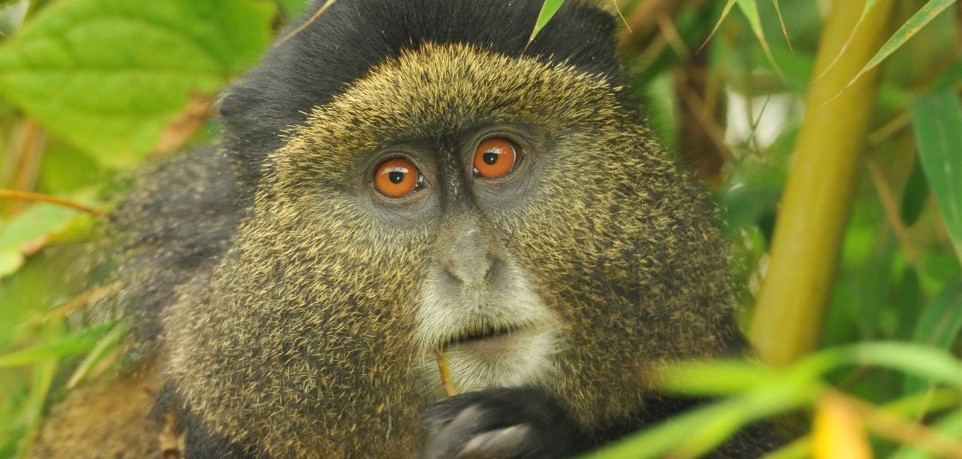
Golden Monkey Habituation in Uganda
Golden monkey habituation in Uganda is one of the top safari activities to look for while on a Uganda primate safari. Uganda has over 20 primate species and Golden monkeys are part of that pool. The golden monkeys are only found within Mgahinga Gorilla National Park in Uganda, which makes the national park a priority destination for those who desire to visit and trek these monkeys. Mgahinga Gorilla National Park is at the heart of the Virunga region to which the golden monkeys are endemic. Golden monkeys are majorly known for the striking physical beauty they wear which is unseen in most of the other monkey species.
They are generally harmonious creatures and fun to watch as they interact with each other. Their fur is brightly colored with a blend of long golden threads hence the reason why they are known as golden monkeys. The fur is also mixed with an orange color which adds to the beauty.
The golden monkeys in Mgahinga National Park are estimated between 2,000 to 4,000 individuals and because of their location, golden monkeys are classified as endangered species. The golden monkeys live in clustered groups of about 100 individuals at a time, and these groups are known as troops. They live in a social set-up under the leadership of an Alpha male. Golden monkeys feed on bamboo leaves and shoots from the bamboo that grows within the forested areas of Mgahinga Gorilla National Park. They also feed on fruits which are known to flourish seasonally, low-lying flowers, sprouts, other plant leaves, lichens, and small forest invertebrates.
Golden monkeys are naturally accustomed to the wilderness and because of this, it primarily makes tourism a complicated activity around these creatures. Consequentially, golden habituation was devised to make them more human-friendly. Mgahinga National Park presently has some habituated troops that can be tracked. Additionally, the park has semi-habituated troops that are present for experimental tourism.
Tracking these monkeys isn’t as complicated as it is for mountain gorillas. The golden monkeys rarely shift their daily nests so there’s no need for pre-tracking. They can always be found in the same specific location they were in the previous day. Experimental tourism is a new phenomenon that has recently been introduced to give desiring tourists an informative insight into the research carried out on the golden monkeys, the conservation efforts of these already endangered species, and the protection activities being carried out amidst the already challenging climate change and rapid human activities.
Golden monkey habituation gives a modest feel of what it is like for the conservationists while in the field, enabling visitors to appreciate the relevance of research in such an environment, learn more about the golden monkeys and other primate species, learn about other animals within Mgahinga Gorilla National Park, and appreciate the interrelationship of golden monkeys with other wild animals within Mgahinga National Park.
How much does golden monkey habituation in Uganda cost?
Golden monkey habituation permits cost $100 for a foreigner, while the tracking permit costs $60 per person.
When to do golden monkey habituation in Uganda?
The dry season of Mgahinga National Park is the best time to visit, and this occurs between the months of July-September and December-February.
Golden Monkey Habituation rules and regulations.
- Ensure that you have secured a trekking permit before embarking on visiting Mgahinga National Park for golden monkey habituation.
- A trekker must be aged above 15 years to be able to take part in the Golden Monkey trekking. This is a precaution taken to avoid dangers that would be associated with very young visitors being in the wilderness.
- As will be guided by the rangers, stand at a reasonable distance from the golden monkeys.
- Sick trekkers, especially those with airborne diseases aren’t allowed to take part in the experience. The reason is to prevent the spread of human diseases to the golden monkeys.
- Hold your property tight, especially cameras and binoculars because the golden monkeys may snatch them from the visitor.
- Avoid littering while in the wilderness.
- Don’t make unnecessary noise while around the golden monkeys.
- Always keep a close distance with your assigned trekking group.
What to pack for golden monkey habituation in Uganda?
Rain jacket, trekking boots, sunglasses, a camera with enough batteries, a pair of binoculars, woolen gardening gloves, hat, snacks, and bottled water.
A detailed introduction to Golden Monkey Habituation in Uganda
Golden Monkey Habituation in Uganda is best understood as more than a name on an itinerary. It is a practical way to experience Uganda through an East African journey, supported by local guiding and enough time to notice landscapes, wildlife, local knowledge and the rhythm of travel between carefully chosen stops. The page above explains the central subject; this planning section adds the decisions that turn that information into a workable trip. Travellers should think about the season, the length of each transfer, the amount of activity they enjoy, the standard of accommodation they prefer and how much unstructured time they want. Careful sequencing matters because driving time, trail conditions and wildlife movement all shape the day. In Uganda, conditions can change between regions even during the same journey, so a route should be checked as a complete sequence rather than as a list of separate attractions. Start with the experience that matters most, then build transport, rest and secondary visits around it. That approach keeps Golden Monkey Habituation in Uganda rewarding for first-time visitors, experienced safari travellers, couples, families and private groups with different interests. For independent protected-area and conservation context, consult Uganda Wildlife Authority and confirm operational details again near the travel date.
How to plan the timing and route
Timing for Golden Monkey Habituation in Uganda is not only a question of choosing a month. It also involves arrival time, road or flight connections, permit availability where controlled activities are included, and the realistic pace of each day. Dry periods can make some roads and trails easier, while greener months may bring dramatic skies, fresh vegetation and fewer visitors in certain areas. Rain can occur in any season, particularly around forests and highlands, so flexibility remains useful. A local planner should confirm current park rules and access before final payment because official conditions can change. Use the Uganda safari collection to compare journeys in the same region, then review the complete safari collection if you may want to combine countries. Arriving a night before a major trek or long game-drive day is often more comfortable than connecting directly from an international flight. When the route covers several borders, build in sensible buffers and avoid treating every transfer as guaranteed to take the shortest possible time.
Further planning resources for Golden Monkey Habituation in Uganda
Compare the destination guides. Use official sources for general background and confirm current fees, access, schedules, permits and operating rules for the exact travel dates before payment. Internal Gorilla Uganda pages help compare route structure and travel style, while the open inquiry form allows a local specialist to check how the information applies to a private journey.