
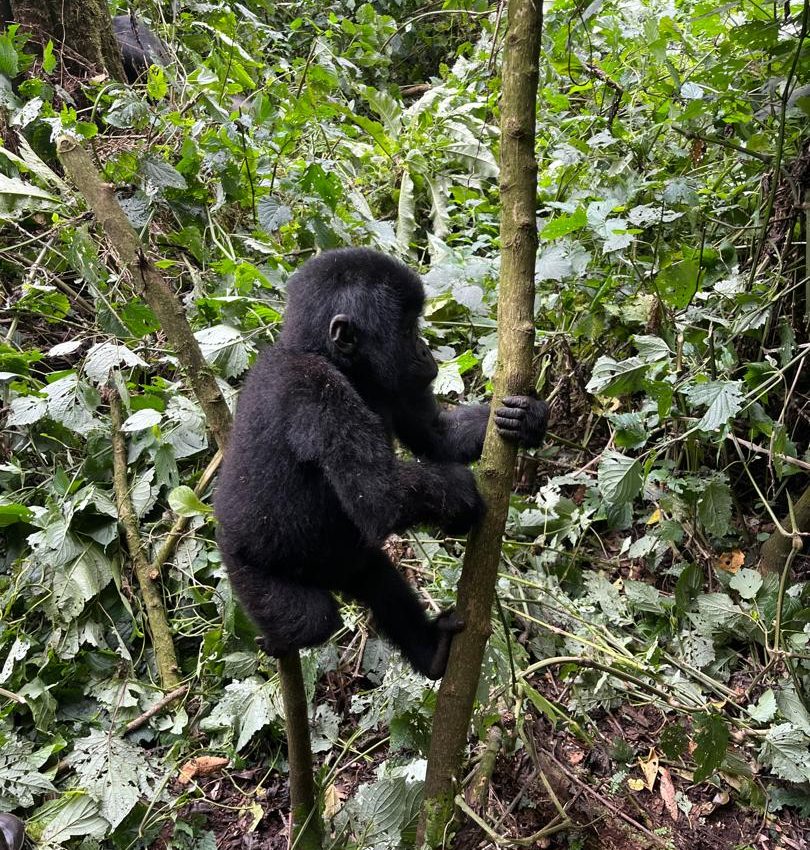
A Step-by-Step Guide to What Happens During Gorilla Habituation in Bwindi. For most travelers, a gorilla trek is a precise, curated event: you wake up, hike for a few hours, spend one strictly enforced hour with a habituated gorilla family, and then depart. It is a breathtaking experience, but it is also a relatively controlled one.
However, deep within the tangled embrace of Bwindi Impenetrable National Park, a different kind of magic unfolds. It is wilder, less predictable, and infinitely more immersive. This is the Gorilla Habituation Experience. Unlike the standard trek, where you are a passive observer, habituation invites you to become a temporary participant in the delicate scientific process of accustoming wild gorillas to the presence of humans.
But what actually happens during those four hours in the forest? What is the rhythm of the morning when you are tracking a group that is not yet fully comfortable with you? Here is a detailed, moment-by-moment account of what happens during Gorilla Habituation in Bwindi.
The Pre-Dawn Assembly
The habituation experience begins earlier than the standard trek. While regular tourists might gather at the park headquarters at 7:00 AM or 8:00 AM, the habituation team often aims to be on the trail by 7:30 AM. The goal is to intercept the gorillas as soon as they wake up.
The day starts at the briefing point in the Rushaga sector (the only area where this experience is currently offered). Here, you are introduced to a specialized team. This isn’t just a ranger; it is a squad that includes lead researchers, trackers, and sometimes armed guards for protection. Because you are visiting wild animals, the briefing is more extensive. You are not just told the rules of “don’t point” and “don’t flash”; you are briefed on the specific mood of the family you are visiting. You might be told, “The Silverback is particularly agitated today,” or “The juveniles are very playful.” This sets the tone: you are entering a dynamic, living situation, not a static exhibit.
Finding the Wild
The hike itself during habituation is distinct. Fully habituated gorillas are accustomed to humans waiting for them, so they rarely move away rapidly. Semi-habituated gorillas, however, are still wary. As you hike, the trackers are using clues not just to find the animals, but to predict their movement.
You might follow fresh trails of broken bamboo, examine the size of dung to estimate how recently they passed, or listen for the subtle “rumb-grunts” of contact calls. The vegetation in Bwindi is aptly named “impenetrable,” and the habituation trails often go off the beaten path. You are macheteing through vines, crossing streams, and climbing steep ridges.
This phase can take anywhere from 30 minutes to several hours. The physical demand is higher, but the anticipation is palpable. You are tracking a family that does not want to be found yet. It is a primal game of hide-and-seek.
The Cautionary Phase
When the trackers finally signal for silence and you prepare to enter the gorilla’s space, the first few minutes are critical. This is the phase that distinguishes habituation from standard trekking.
In a normal trek, the gorillas might glance at you and keep eating. During habituation, the reaction is often dramatic. You might hear the Silverback let out a loud, chest-beating roar, a warning to stay back. The females might gather the infants and retreat into the dense thicket. You may see only a black hand or a pair of eyes peering through the leaves for the first 20 minutes.
This is where the patience of the habituation process is tested. You are instructed to crouch down, look away, and make low, soothing grunting noises (the “gorilla language” of reassurance). The researchers and trackers use these moments to slowly acclimate the animals. They sit quietly, demonstrating that the humans are not a threat.
During this phase, you are essentially part of the experiment. Your calm, non-threatening presence helps the gorillas realize that you are not a predator. You are witnessing the very first shaky steps of trust between man and beast.
The Four-Hour Window
The standard one-hour trek allows for a “greatest hits” reel: look at the baby, look at the Silverback, take a photo, and leave. The four-hour habituation permit allows for a documentary.
You witness the full cycle of their morning activity. You might watch them feed for two hours, stripping the bark from trees with incredible dexterity. You might see them move to a new nesting site to rest. You might see them engage in a play session that lasts 45 minutes.
For photographers, this is nirvana. You have the time to adjust your settings, to wait for the perfect lighting through the canopy, and to capture behavioral sequences rather than just portraits.
Moreover, you are with the researchers. As you watch, the researchers are taking notes. They point out things a layperson would miss. “Look at the female on the left,” a researcher might whisper. “She has a wound on her shoulder; we need to monitor that for infection.” Being privy to this scientific observation adds a layer of intellectual depth to the experience. You aren’t just a tourist; you are a silent assistant in the conservation of the species.
The Lunch Break
Around midday, a unique aspect of the habituation experience occurs: the human lunch break. Unlike standard trekkers who must leave the forest immediately after their hour is up, habituators stay.
You will find a spot a safe distance from the gorillas to eat your packed lunch. This is a surreal experience. You are sitting on the forest floor, maybe on a log, eating a sandwich, while 20 meters away, a family of gorillas is doing the exact same thing. The sounds of the forest create a soundtrack that feels primordial. It is a moment of peaceful coexistence that is rarely felt in the modern world.
Leaving Them Wild
Eventually, the four hours draw to a close. The trek back is often reflective. You have seen these animals in a state that few humans ever will. They are not the “performers” of the fully habituated groups; they are wild animals struggling to accept the intrusion of humans.
As you leave, you realize that the habituation process is not just about making life easier for tourists. It is about saving the species. Only habituated gorillas can be monitored closely by veterinarians. Only habituated gorillas bring in the tourism revenue that funds the park rangers who protect them from poachers. By participating in this experience, you have played a small, vital role in that conservation chain.
Conclusion
What happens during Gorilla Habituation in Bwindi is a slow unfolding of nature. It is a narrative without a script, characterized by moments of high tension, periods of boredom, and flashes of pure, transcendent joy. It is the difference between watching a movie and living it. For those willing to make the hike and embrace the uncertainty, the habituation experience offers the most authentic and profound window into the world of the mountain gorilla possible today. It is a reminder that in the wild, patience is the currency of the greatest rewards.
Further planning resources for What happens during Gorilla Habituation in Bwindi?
Compare the complete safari package library, destination guides, safari experiences, Gorilla Uganda travel journal. For independent destination and conservation context, consult Uganda Wildlife Authority. Use official sources for general background and confirm current fees, access, schedules, permits and operating rules for the exact travel dates before payment. Internal Gorilla Uganda pages help compare route structure and travel style, while the open inquiry form allows a local specialist to check how the information applies to a private journey.