
Where do Mountain Gorillas live?
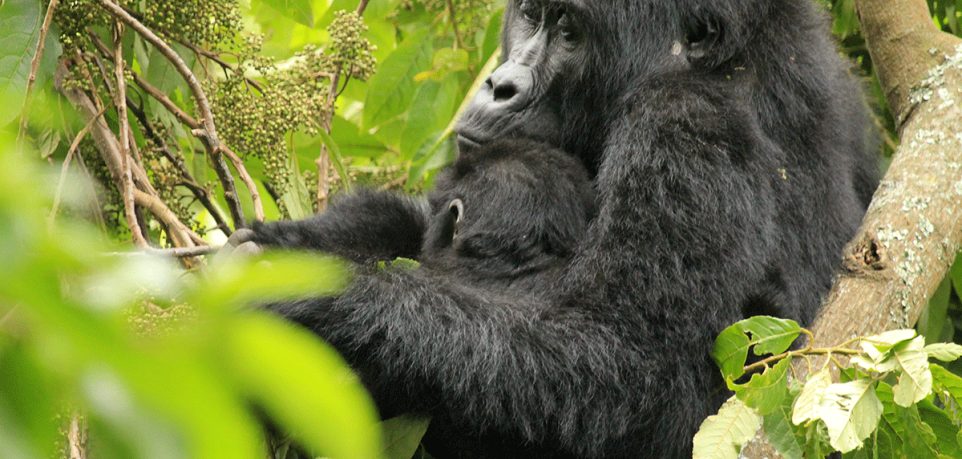
Where do mountain gorillas live? Mountain gorillas live in the dense rainforests of Africa mainly Uganda, Rwanda, and the Democratic Republic of Congo. of Mountain gorillas are a subspecies of eastern gorillas and are generally awesome creatures. These primates have unique features although with some similarities to other primates especially as regards physical attributes. Mountain gorillas are found in East Africa and whoever wants to physically trek them, has only one location as their destination.
Countries where gorillas live
Mountain gorillas are limited to only three countries globally – Uganda, D.R. Congo, and Rwanda. The three countries have a total population of more than 1,000 mountain gorillas fairly distributed among the three countries. Uganda however, has almost half the world’s population of mountain gorillas, with the rest shared by the other two countries.
In Uganda, they are situated in Bwindi Impenetrable National Park, also doubling as the park with the highest number of mountain gorillas in Uganda; as well as Mgahinga National Park. Both parks are located in South Western Uganda. Volcanoes National Park is where they can be found in Rwanda and Virunga National Park for D.R. Congo.
This collection of these three countries is known as the “Virunga region.” The reason is that the area has 8 Virunga volcanoes. These include mountains Sabinyo, Mikeno, Mgahinga, Karisimbi, Nyamuragira, Nyiragongo, Bisoke, and Muhabura. These mountains have fertile soils that have enabled the growth of rainforests and alpine vegetation that have helped the flourishing of a suitable ecosystem in which the mountain gorillas have survived for many years.
Interesting facts about mountain gorillas
Mountain gorillas live in family units.
The family head is known as a silverback (an adult male gorilla).
There are about 1,063 individual gorillas globally.
They are one of the largest and strongest primates.
They share about 95% DNA similarity to humans.
They can live up to 40 years.
They are endangered.
How different are mountain gorillas from other species of gorillas?
The other species of gorillas are Grauer’s gorillas/ Eastern lowland gorillas. The two species i.e., Eastern lowland gorillas and mountain gorillas have some differences as listed below;
Areas of breeding. Mountain gorillas live in potentially mountainous areas while Grauer’s gorillas live in lowland areas.
The Grauer’s gorillas can only be trekked in D.R Congo, whereas mountain gorillas in D.R Congo, Rwanda, and Uganda.
Mountain gorillas have thicker fur compared to Grauer’s gorillas.
Mountain gorillas have darker fur compared to Grauer’s gorillas.
Grauer’s gorillas weigh more than ordinary mountain gorillas.
Grauer’s have a higher standing height as compared to the mountain gorillas.
I am trekking mountain gorillas.
Gorilla trekking is the most common activity done in mountain gorilla tourism. Gorilla trekking is available in all three countries and it’s done with the help of a guide who eases the tracking of mountain gorillas since they keep shifting their nests. Trekking involves a hike too since the areas in which mountain gorillas live are mainly mountainous. The trekking is done in groups of 8 people.
People are first issued instructions that they must observe while on the trek. Since it includes a mild hike, tourists should be fairly physically fit to have an easy experience. It’s open to tourists aged 15 years and above. Gorilla trekking is carried out by habituated groups or families within the respective mountain gorilla trekking locations. Each family has its uniqueness, but overall, the trekking experience is memorable.
What is the cost of trekking mountain gorillas?
The cost of trekking varies from one location to another. Each of the three countries has unique processes and prices. For one to engage in trekking, they first of all must have a “trekking permit.” This is the document that enables one to access the trekking sites.
Rwanda’s permits are at $1,500 each. Uganda’s at $800 for foreign non-residents, $600 for foreign residents, and 250,000/= UGX for East African citizens. D.R. Congo’s is $200 for Congolese nationals and $450 for foreign trekkers.
What is the best time to visit mountain gorillas?
The rainy season is very disruptive, and therefore a recommendation is made for tourists to partake in visiting mountain gorillas during the dry season. There are two dry seasons in the Virunga region, annually—July to September, and later between December to February. Tourists enjoy the advantages that come with sunshine during those periods and therefore, these seasons are the most recommended.
A detailed introduction to Where do Mountain Gorillas live?
Where do Mountain Gorillas live? is best understood as more than a name on an itinerary. It is a practical way to experience East Africa through gorilla trekking, supported by local guiding and enough time to notice a guided forest trek and a carefully managed encounter with habituated gorillas. The page above explains the central subject; this planning section adds the decisions that turn that information into a workable trip. Travellers should think about the season, the length of each transfer, the amount of activity they enjoy, the standard of accommodation they prefer and how much unstructured time they want. The strongest itineraries leave room for real observations instead of rushing from one headline sight to another. In East Africa, conditions can change between regions even during the same journey, so a route should be checked as a complete sequence rather than as a list of separate attractions. Start with the experience that matters most, then build transport, rest and secondary visits around it. That approach keeps Where do Mountain Gorillas live? rewarding for first-time visitors, experienced safari travellers, couples, families and private groups with different interests. For independent protected-area and conservation context, consult UNESCO’s Bwindi overview, IUCN mountain gorilla conservation information and confirm operational details again near the travel date.
How to plan the timing and route
Timing for Where do Mountain Gorillas live? is not only a question of choosing a month. It also involves arrival time, road or flight connections, permit availability where controlled activities are included, and the realistic pace of each day. Dry periods can make some roads and trails easier, while greener months may bring dramatic skies, fresh vegetation and fewer visitors in certain areas. Rain can occur in any season, particularly around forests and highlands, so flexibility remains useful. A local planner should confirm current park rules and access before final payment because official conditions can change. Use the East Africa safari collection to compare journeys in the same region, then review the complete safari collection if you may want to combine countries. Arriving a night before a major trek or long game-drive day is often more comfortable than connecting directly from an international flight. When the route covers several borders, build in sensible buffers and avoid treating every transfer as guaranteed to take the shortest possible time.