
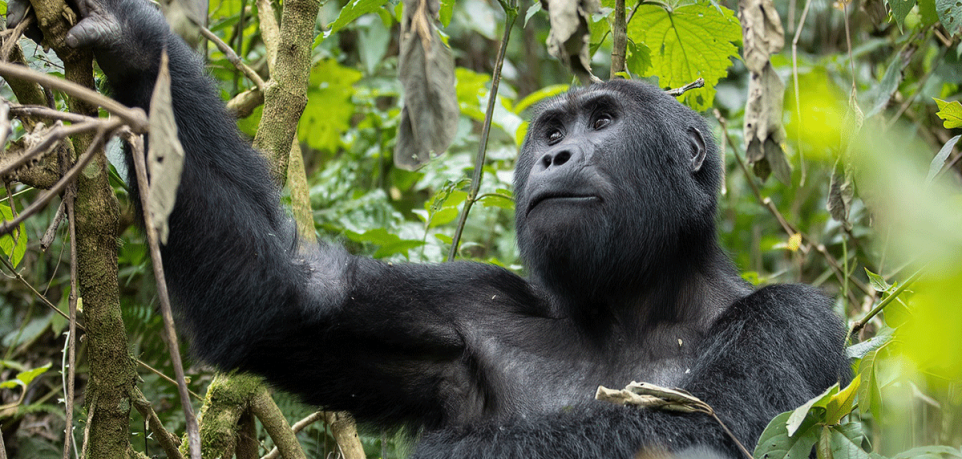
How do mountain gorillas reproduce?
Mountain Gorilla Reproduction: A male gorilla can weigh up to 180 kg, and females typically weigh 90 kg, making them the biggest living apes and largest primates. Since humans and gorillas share about 98% of their genetic composition, they resemble humans more in personality and conduct. The emotions of joy and grief, social relationships, and physical appearance which show that both humans & gorillas have four limbs, are some of the similarities. There are thought to be 1063 mountain gorillas in the entire globe.
Each of the two gorilla species, western and eastern gorillas has two subspecies. The Cross River Gorilla and Western Lowland Gorilla are the two additional subspecies of western gorillas, whilst Eastern gorillas are further separated into Eastern Lowland Gorillas (known as Grauer’s Gorillas) and renowned and endangered Mountain Gorillas.
Gorillas are considered newborns until they reach the age of 8, at which point they are referred to as adults. Male adults aged 8 to 12 are known as blackbacks, and once they turn 12, they are known as silverbacks because they have begun to develop gray hair on their backs.
Female gorillas give birth to their first babies once they are around ten years old and have an 8.5-month gestation period. Multiple births, such as having twins, are extremely uncommon in gorillas. Male gorillas are polygamous and usually mate with several females during their lifetime.
The Virunga mountain range, which is shared by Democratic Republic of the Congo, Rwanda, and Uganda is home to mountain gorillas as well as Bwindi Impenetrable National Park in southwestern Uganda. These apes differ from their lowland counterparts in that they have longer hair and shorter arms, as well as muscular arms and chests and large hands and feet. In comparison to other gorilla species, they also weigh less—roughly between 300 and 485 pounds. They are the only ones who inhabit higher altitudes, and their thick, lengthy fur keeps them warm by protecting them from the cold.
Similar to humans, they too live in families. The majority of these families have more than 10 members, with the silverback serving as the alpha male. Both males and females are in charge of raising the young; as males get older, they typically break away from their families to form their own or join another. Larger gorilla groups frequently fight, and the females’ relationship with the dominant silverback is crucial to the group’s stability. Gorillas are more composed, tranquil, tenacious, and intellectual. Together, they sleep in nests they have built on both trees and the ground. They enjoy cuddling together during the night.
They spend over six hours every day feeding on leaves, roots, fruits, and small insects as well. Their lifespan can reach 40 years, especially if they are left in the wild alone.
Where to enjoy Mountain Gorilla Trekking Tours?
Gorilla Trekking Tours in Rwanda
In Rwanda’s Volcanoes National Park, which is home to over 300 mountain gorillas, visitors can encounter these primates seamlessly. There are 12 habituated gorilla groups in this area that can be trekked. One of these is the Susa group, which resides high on Mount. Karisimbi was studied by renowned primatologist Dian Fossey. Rwanda is the most costly country to visit because gorilla trekking permits here cost $1500 each. In September every year in Musanze, the primary town for gorilla safaris, Rwanda organizes an annual ceremony where young gorillas are named.
Gorilla Trekking Tours in Uganda
The best mountain gorilla trekking experience in Uganda can be obtained in Bwindi Impenetrable National Park. Comprising of 21 groups with about 600 gorillas in total. However, some more can be found in Uganda’s second gorilla destination – Mgahinga Gorilla National Park. There is only one group here, which is fully habituated for visitation every day.
Although Bwindi impenetrable is and as inaccessible as it sounds, it does provide gorilla habituation experiences where you can spend about four hours with a semi-habituated group. Because the members of this group are unpredictable, this is a much more exciting experience than with habituated gorillas where you can be sure they are accustomed to humans. The cost of this activity is $1500 and gorilla trekking which is relatively cheaper in Uganda than in Rwanda goes for $700.
Gorilla Trekking Safaris in D.R. Congo
Virunga National Park in the Democratic Republic of Congo also provides gorilla trekking adventures. Within the Virunga Mountains, it provides the most daring and affordable options; the permits only cost $450. Although there are only 7 gorilla groups in the park, security is still a concern there. It is therefore advised to visit the gorillas as part of a planned tour where all aspects, including security, are taken care of.
A large population of Grauer’s gorillas, sometimes known as Eastern Lowland gorillas, which are over 5,000 can also be found in the D.R. Congo within the Kahuzi-Biega National Park, home to both mountain and lowland gorillas, making D.R. Congo the only country to host both gorilla species.
A detailed introduction to How do mountain gorillas reproduce?
How do mountain gorillas reproduce? is best understood as more than a name on an itinerary. It is a practical way to experience East Africa through gorilla trekking, supported by local guiding and enough time to notice a guided forest trek and a carefully managed encounter with habituated gorillas. The page above explains the central subject; this planning section adds the decisions that turn that information into a workable trip. Travellers should think about the season, the length of each transfer, the amount of activity they enjoy, the standard of accommodation they prefer and how much unstructured time they want. A good plan protects the quality of the experience without making the journey feel rigid. In East Africa, conditions can change between regions even during the same journey, so a route should be checked as a complete sequence rather than as a list of separate attractions. Start with the experience that matters most, then build transport, rest and secondary visits around it. That approach keeps How do mountain gorillas reproduce? rewarding for first-time visitors, experienced safari travellers, couples, families and private groups with different interests. For independent protected-area and conservation context, consult UNESCO’s Bwindi overview, IUCN mountain gorilla conservation information and confirm operational details again near the travel date.
How to plan the timing and route
Timing for How do mountain gorillas reproduce? is not only a question of choosing a month. It also involves arrival time, road or flight connections, permit availability where controlled activities are included, and the realistic pace of each day. Dry periods can make some roads and trails easier, while greener months may bring dramatic skies, fresh vegetation and fewer visitors in certain areas. Rain can occur in any season, particularly around forests and highlands, so flexibility remains useful. A local planner should confirm current park rules and access before final payment because official conditions can change. Use the East Africa safari collection to compare journeys in the same region, then review the complete safari collection if you may want to combine countries. Arriving a night before a major trek or long game-drive day is often more comfortable than connecting directly from an international flight. When the route covers several borders, build in sensible buffers and avoid treating every transfer as guaranteed to take the shortest possible time.