
7 Days Rwenzori Hiking from Kasese is an immersive mountain adventure through one of Uganda’s most spectacular high-altitude landscapes. Starting from Kasese and continuing into the Rwenzori Mountains National Park, this trek takes you from the lower mountain forests into bamboo zones, high-altitude moorlands, and the dramatic alpine landscapes that make the Rwenzori different from almost any other mountain destination in Africa. Rather than simply travelling to a viewpoint and returning, you spend several days moving through the mountain ecosystem, sleeping at mountain camps and gradually experiencing the dramatic changes in vegetation and climate as the altitude increases.
The Rwenzori Mountains are often called the Mountains of the Moon and rise along western Uganda near the border with the Democratic Republic of Congo. The range is approximately 120 kilometres long and 65 kilometres wide, with its highest point, Margherita Peak on Mount Stanley, reaching 5,109 metres. The park was declared a UNESCO World Heritage Site in 1994.
This 7 Days Rwenzori Hiking from Kasese package is designed for travellers who want a serious multi-day mountain experience without necessarily committing to one of the longer expeditions required for the highest summit attempts. The exact route, camps and highest point reached depend on the trail and mountain objective selected, as the Rwenzori has several established trekking routes, including the Central Circuit and Kilembe Trail.
Planning a Rwenzori trek from Kasese? Native Africa Tours can arrange the mountain permits, transfers, guides, accommodation before and after the trek, porters, and the logistics needed for your seven-day adventure.
The Idea Behind This 7-Day Rwenzori Trek
Instead of measuring this journey simply by the number of kilometres covered each day, think of it as a seven-day progression through different mountain worlds. You begin in the Kasese area, where the climate is considerably warmer, and the surrounding landscape is dominated by lower-altitude vegetation and communities. As the trail climbs, the environment changes. Forest gives way to bamboo and montane vegetation, followed by moorland and the distinctive giant vegetation associated with the higher Rwenzori.
Eventually, the landscape becomes increasingly alpine, with rocky terrain, mist, cold temperatures, and dramatic mountain scenery. The experience is not just about reaching a particular point on the mountain; it is about witnessing this extraordinary ecological transition on foot.
That gradual transformation is one of the biggest reasons to choose 7 Days Rwenzori Hiking from Kasese instead of treating the Rwenzori as a simple day excursion.
Your Trek at a Glance
| Trek Element | Details |
|---|---|
| Duration | 7 Days / 6 Nights |
| Starting Area | Kasese, western Uganda |
| Mountain | Rwenzori Mountains |
| Protected Area | Rwenzori Mountains National Park |
| Main Experience | Multi-day mountain trekking |
| Trail | Selected Rwenzori trekking route |
| Highest Point | Depending on selected route and trekking objective |
| Accommodation | Mountain huts/camps and pre/post-trek accommodation |
| Guide | Professional mountain guide and support crew |
| Porters | Available as part of the trekking arrangement |
| Difficulty | Challenging |
| Best For | Experienced hikers and physically prepared adventure travellers |
| Starting Point | Kasese |
| Ending Point | Kasese |
The precise trail and highest elevation reached should be confirmed when booking because the Rwenzori has different trekking routes and objectives.
Rwenzori Hiking Route Map
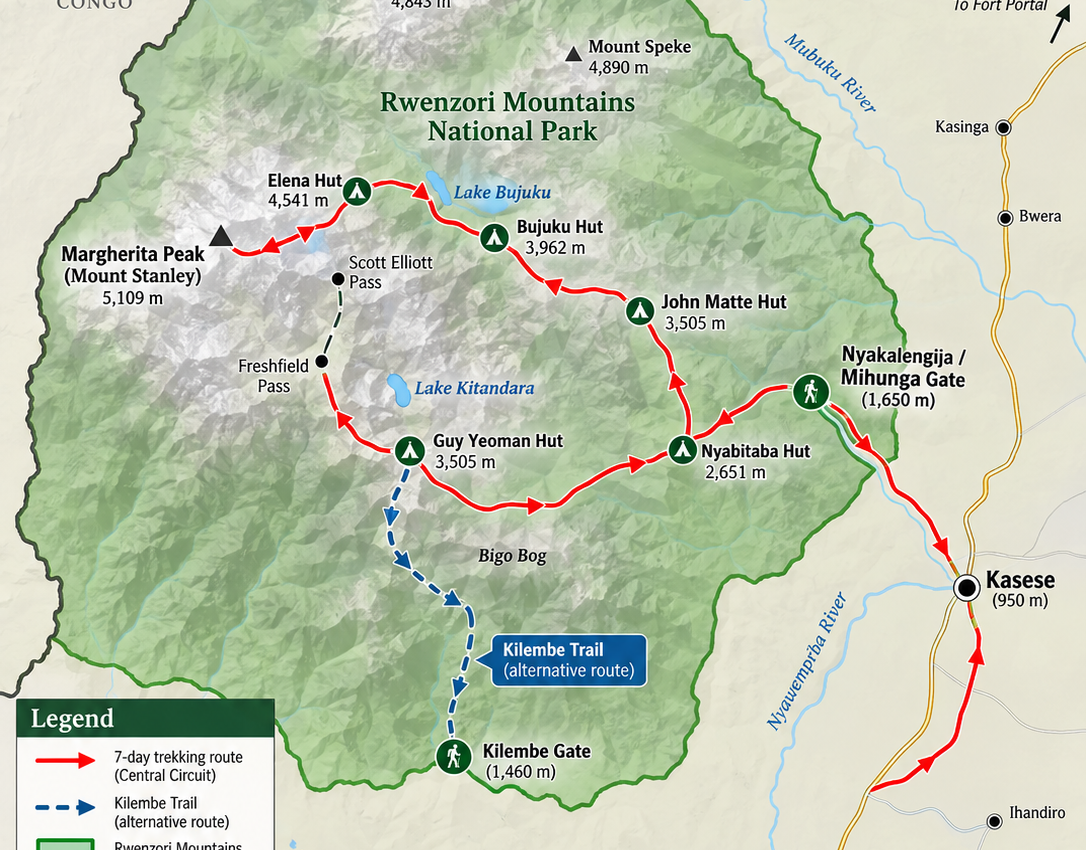
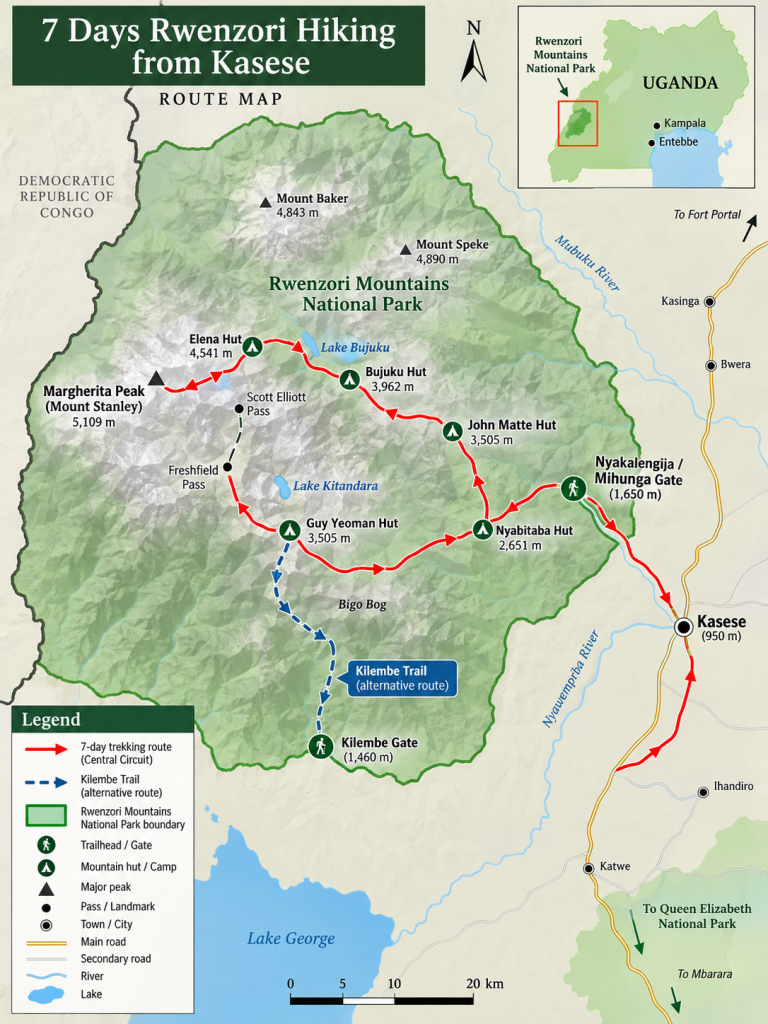
The map below gives you a clear visual overview of the 7 Days Rwenzori Hiking from Kasese route, showing the main trailhead, mountain camps, high-altitude sections and key landmarks along the journey. It helps you understand how the trek progresses from Kasese into the Rwenzori Mountains and through the different stages of the mountain adventure. The exact route and highest point reached may vary depending on the selected trekking trail and objective.
The Seven-Day Journey
Stage 1: Kasese to the Rwenzori Trailhead
Your Rwenzori adventure begins in the Kasese area with preparation for the mountain trek. Depending on the route selected, you transfer from Kasese to the appropriate trailhead before beginning the ascent.
The first day is intentionally more about entering the mountain environment than trying to gain extreme altitude immediately. The trail gradually takes you away from the settlements and agricultural areas surrounding the mountain and into the forested lower slopes. This is also an important opportunity for your guide and trekking team to check equipment, confirm the day’s walking arrangements, and ensure that everyone understands the pace and conditions ahead.
Stage 2: Into the Montane Forest
As the trek continues, the character of the Rwenzori begins to change. The lower slopes are covered by rich montane forest, creating a very different atmosphere from the open landscapes around Kasese.
The forest section is particularly rewarding for travellers who enjoy nature rather than simply chasing altitude. The Rwenzori supports a remarkable range of habitats, and its forests, bamboo zones, moorlands and high-altitude vegetation are some of the defining features of the park.
Walking through this environment also makes the journey feel progressively more remote. The sounds of the surrounding forest, changing vegetation, and occasional mist become part of the experience as the trail climbs higher.
Stage 3: Bamboo and Heather Zones
Higher on the mountain, the forest gradually gives way to bamboo and other high-altitude vegetation.
This is where the Rwenzori begins to look increasingly different from the tropical forests encountered elsewhere in Uganda. The vegetation becomes more unusual, the trail more rugged, and the weather more unpredictable. At this stage, maintaining a steady walking rhythm becomes important. A Rwenzori trek is not a race. The most effective approach is generally to walk at a manageable pace, allowing the body to adapt progressively while giving you enough energy for the higher sections of the route.
Stage 4: Entering the Moorlands
The moorland zone is one of the most visually distinctive parts of the Rwenzori. Giant lobelias, giant groundsels, moss-covered terrain and open mountain landscapes create the surreal scenery for which the range is famous. Mist can move quickly across the mountains, sometimes transforming the landscape within minutes.
This is also where the trek begins to feel significantly more alpine. Temperatures become colder, and the terrain can become wet, muddy, and uneven. The mountains are exceptionally wet, with rain possible even during traditionally drier periods, while temperatures can fall below freezing after dark at higher elevations.
Stage 5: The High Mountain Environment
The higher you climb, the more dramatic the landscape becomes. Rocky ridges, high-altitude valleys, enormous vegetation, and views toward the surrounding peaks create a completely different environment from the lower forest.
At this point, the focus is no longer simply on walking from one destination to another. The mountain itself becomes the experience. Depending on your selected route and trekking objective, this stage can bring you into the higher mountain environment around some of the Rwenzori’s major peaks and camps.
Uganda Wildlife Authority has also invested in improving facilities and safety infrastructure in the high Rwenzori. In 2024, UWA received the new Elena Camp at approximately 4,500 metres, together with mountaineering and safety equipment.
Stage 6: High-Altitude Trekking and Mountain Scenery
By the sixth stage, you will have spent several days adapting to the mountain environment. The scenery becomes increasingly dramatic, but so does the physical challenge. Cold weather, wet conditions, altitude, and uneven terrain can make relatively short distances feel much harder than they would at lower elevations.
Your guide’s role becomes particularly important here. The aim is to maintain a safe pace and make decisions according to weather, trail conditions, altitude, and the ability of the trekking group. If the itinerary includes a particular high-altitude objective, the day’s activities will depend on the route and conditions rather than following a rigid schedule regardless of circumstances.
Stage 7: Descending Back Toward Kasese
The final stage brings the journey back down from the mountain. Descending is often physically different from climbing. While the altitude becomes easier, tired legs and wet or slippery sections can make the descent demanding. Your trekking team will continue to guide the group through the remaining sections of the route until you reach the trailhead.
From there, you transfer back toward Kasese for a well-earned rest. The contrast can be striking. Within a relatively short period, you have moved from cold high-altitude terrain back toward the warmer environment of western Uganda.
What Makes the Rwenzori Different?
The Rwenzori should not be marketed simply as another African mountain. Unlike volcanic mountains such as Mount Kilimanjaro, the Rwenzori is a massive block mountain range created through tectonic activity. Its combination of equatorial location, high altitude, glaciers, forests, moorlands and unusual giant plants produces an environment that feels remarkably different from other trekking destinations.
The Rwenzori is a landscape ranging from montane forests and bamboo woodlands to moorlands and equatorial snow-covered peaks. For a traveller who has already experienced Uganda’s gorillas, chimpanzees and savannah wildlife, a 7 Days Rwenzori Hiking from Kasese experience provides an entirely different side of the country.
How Difficult Is 7 Days Rwenzori Hiking?
This is not a beginner’s sightseeing trip.
A seven-day Rwenzori trek requires good physical preparation because you will be walking for several consecutive days at increasing altitude. The difficulty comes from the combination of distance, elevation gain, wet conditions, uneven ground, cold temperatures, and the possibility of rapidly changing mountain weather.
You do not need to be an elite athlete, but you should be comfortable with long days of walking and be prepared for conditions that can be considerably more demanding than ordinary hiking. Training with long walks, hills, stair climbing and loaded daypacks before your trip can make a significant difference.
What You Will See Along the Way
The attraction of the Rwenzori isn’t limited to the final destination. You will experience a succession of landscapes as you climb: Kasese lowlands → montane forest → bamboo → heather and moorland → high-altitude alpine terrain → mountain peaks and valleys.
The vegetation is particularly remarkable. Giant lobelias, giant groundsels, moss-covered rocks and unusual high-altitude plants give sections of the mountain an almost otherworldly appearance. Wildlife and birdlife can also be encountered in the lower forest zones, although this is primarily a mountain trekking experience, rather than a conventional wildlife safari.
When Should You Go?
The Rwenzori can be trekked at different times of the year, but weather is an important consideration. January and June–July are traditionally favourable periods because they are among the drier periods, while also noting that rain can occur even during drier months.
This is why we recommend planning around the mountain conditions rather than assuming that a particular month guarantees dry weather. The Rwenzori is a wet mountain environment, and rain, mist, and cold temperatures are part of what makes the experience distinctive.
What Should You Pack?
Your packing list should be designed around cold, wet, and changing mountain conditions. Essential equipment includes waterproof clothing, warm layers, waterproof trousers, good trekking footwear, gloves, a headlamp, personal medication, energy snacks, and waterproof bags for protecting clothing and equipment.
A good sleeping bag and sleeping mat are also important where the accommodation arrangement requires them. We recommend warm clothing, rain gear, waterproof trousers, a head-mounted torch, a sleeping bag, and a camping mat. One particularly useful principle is to keep your spare clothes dry. Wet clothing becomes a much bigger problem once temperatures fall at higher altitude.
Accommodation During the Trek
Mountain accommodation is very different from staying at a safari lodge. Depending on the route, you will spend nights in mountain camps or shelters rather than conventional hotels. There are basic shelters on the Kilembe and Central Circuit routes, while newer facilities such as Elena Camp have improved accommodation at higher elevations.
For this reason, the trek should be approached as an expedition rather than a luxury holiday. We normally recommend spending a night in Kasese before the trek where appropriate. This gives you time to rest, prepare your equipment, and meet the trekking team before entering the mountains.
Guides, Porters and the Trekking Team
A professional mountain team makes a major difference to the experience. Your guide leads the route, monitors the progress of the group, and helps manage changing trail and weather conditions. Porters can carry equipment and reduce the physical load on hikers, allowing you to concentrate more on the actual trek.
The Rwenzori trekking system also has an important connection with surrounding communities. The trekking routes employ local guides, porters, chefs, and other community members. Choosing a properly organized trek therefore contributes not only to your experience but also to the local tourism economy around the mountain.
Is This the Same as Climbing Margherita Peak?
This distinction is important for the package page. Margherita Peak is the highest point of the Rwenzori at 5,109 metres, but a seven-day hiking itinerary should not automatically be marketed as a Margherita summit expedition.
Summit climbing is a considerably more demanding activity, with Margherita summit expeditions generally requiring longer itineraries and technical preparation. Therefore, if the client specifically wants to summit Margherita Peak, we should quote and structure that as a dedicated mountaineering expedition rather than simply selling this seven-day hiking package.
Why Start Your Rwenzori Adventure From Kasese?
Kasese is the natural base for exploring the Rwenzori on the Ugandan side. The town also works well for travellers combining mountain trekking with other western Uganda experiences. After the trek, you can continue to destinations such as Queen Elizabeth National Park, Kibale National Park or Semuliki National Park, depending on your wider travel plans.
This makes a Rwenzori trek particularly attractive as an extension to a Uganda safari rather than as an isolated mountain trip. For example, a traveller could combine: Entebbe → Queen Elizabeth → Kasese → Rwenzori → Kibale → Entebbe
That creates a journey combining savannah wildlife, mountain trekking and primate experiences in one itinerary.
A Better Way to Experience Western Uganda
One of the strongest selling points of this package is the contrast it creates. You can spend one part of your Uganda holiday watching elephants and lions on the savannah and another part walking through mist-covered mountain forests thousands of metres above the surrounding plains.
That combination makes the 7 Days Rwenzori Hiking from Kasese package particularly suitable for adventure travellers who want more than a traditional safari. It is also an excellent option for travellers who have already visited Uganda’s better-known wildlife destinations and want to explore a less conventional side of the country.
What Is Included?
Your final package inclusions should be based on the exact route and quotation, but the package can be presented around the core trekking services:
- Rwenzori trekking arrangements
- Mountain guide
- Porter support
- Applicable park and trekking fees
- Mountain accommodation during the trek
- Accommodation before/after the trek where included
- Meals during the mountain trek
- Transportation from Kasese to the trailhead and back
- Drinking water during the trek where provided
- Pre-trek briefing
- Safari vehicle/driver for the ground transfers
Specific technical equipment, personal hiking gear, travel insurance, international flights and other personal expenses should be clearly identified as exclusions where applicable.
Who Is This Trek Best For?
This trek is best suited to adventure travellers, experienced hikers, photographers, nature enthusiasts and travellers looking for a physically demanding Uganda experience. It is particularly attractive to someone who wants to spend several days immersed in the Rwenzori rather than simply visiting the mountain for a short walk. If your priority is luxury accommodation, easy walking and short transfers, this is probably not the right Uganda package. If your priority is mountain scenery, physical challenge, remote landscapes and an authentic trekking experience, it can be an excellent choice.
Frequently Asked Questions
How difficult is the 7 Days Rwenzori Hiking from Kasese?
The trek is challenging because of the altitude, long walking days, steep sections, wet terrain and rapidly changing weather. Good physical preparation is strongly recommended.
Does the seven-day trek reach Margherita Peak?
Not automatically. The Rwenzori has different routes and trekking objectives. A dedicated Margherita summit expedition requires additional planning, technical preparation, and an appropriate itinerary.
Where does the trek start?
The trek begins from a Rwenzori trailhead reached from Kasese. The exact trailhead depends on the route selected, such as the Nyakalengija-based Central Circuit or Kilembe Trail.
Can I combine Rwenzori hiking with a Uganda safari?
Yes. The Rwenzori is located in western Uganda, making it practical to combine mountain trekking with destinations such as Queen Elizabeth National Park and Kibale National Park.
What is the best time for Rwenzori hiking?
January and June–July are traditionally regarded as more favourable periods, although weather can change quickly and rainfall can occur throughout the year.
Do I need a porter?
A porter is highly recommended for a multi-day Rwenzori trek. Porters can carry part of your equipment and make the physical demands of the hike more manageable.
Start Planning Your Rwenzori Adventure
A 7 Days Rwenzori Hiking from Kasese experience is not simply a seven-day walk. It is a journey through one of Uganda’s most extraordinary mountain environments, from forested foothills to high-altitude moorlands and dramatic alpine landscapes.
At Native Africa Tours, we can help organize the trekking arrangements, trail logistics, transportation from Kasese, guides, porters, and accommodation needed for your journey. We can also combine the Rwenzori trek with Queen Elizabeth, Kibale, Bwindi, or other western Uganda destinations if you want to turn the mountain experience into a longer Uganda adventure.
Ready to hike the Mountains of the Moon? Contact Native Africa Tours and let us design your Rwenzori trekking itinerary from Kasese around your fitness level, preferred route, and travel dates.